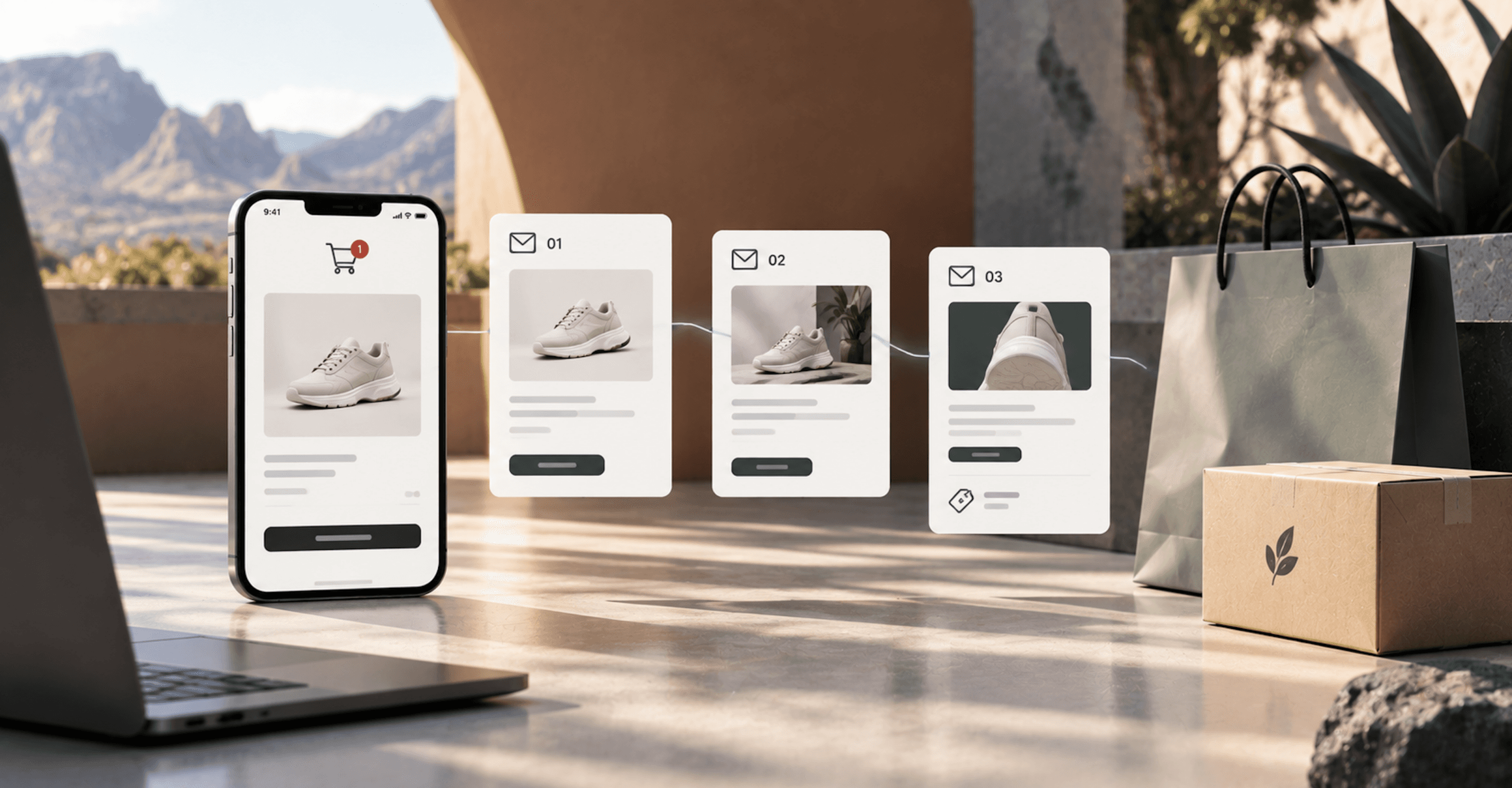
An abandoned cart email goes to someone who got far enough into your store to be identified and then left. We build these flows for Shopify brands, mostly on Klaviyo, and we tune them ahead of peak season. Peak traffic runs every setting in a cart flow at full volume, whether or not anyone has checked it.
The abandoned cart recovery build we’d walk a client through comes down to four decisions in cart abandonment messaging: when the first message goes out, who gets a discount, where one text fits, and who you’re allowed to email in the first place.
Timing comes first, because a peer-reviewed field experiment cuts against sending fast. In randomized experiments on more than 40,500 customers, published in the Journal of Marketing (opens in new tab), Li, Luo, Lu and Moriguchi found that shoppers who got a cart reminder within 30 minutes to one hour of abandoning were less likely to buy than shoppers who got nothing. Reminders that arrived one to three days later had a positive incremental effect.
How Abandoned Cart Recovery Works, From Cart Abandonment to Inbox
Shopify splits recovery into three automations in its Shopify Messaging app (opens in new tab). Recover abandoned cart sends a marketing message to customers who add products to their cart but don’t start the checkout process. Recover abandoned checkout sends a marketing message to customers who start the checkout process but don’t complete an order. The third, browse abandonment, targets shoppers who view at least one product and leave without adding it to the cart.
For the checkout tier, Shopify’s legacy abandoned checkout emails treat a checkout as abandoned (opens in new tab) if it remains incomplete for more than ten minutes after the customer has provided their email information.
Klaviyo's Default Abandoned Cart Email Is a Checkout Email
Klaviyo’s naming blurs the first two tiers. Most of its pre-built abandoned cart flows trigger on the Started Checkout metric (opens in new tab), which fires once a customer has filled out contact information and moved on to the shipping page, or reloaded the page, depending on the integration. The default Klaviyo abandoned cart flow is triggered by the Shopify Checkout Started event, whereas the Added to Cart abandoned cart flow (opens in new tab) targets more casual shoppers who have yet to start checkout.
Is an abandoned cart email the same thing as an abandoned checkout email? In Shopify’s vocabulary, no. One follows an add to cart, the other a started checkout.
In Klaviyo’s default setup, though, the flow called abandoned cart is a checkout flow, so the shopper reading your abandoned cart email has usually already reached the shipping step. Write that email for a shopper who may have left over something the checkout showed them.
Who an Added to Cart Flow Can Reach
The lighter tier takes more setup and reaches fewer people. On Shopify, you’ll need to enable the Klaviyo app embed and check the integration setting Track behavioral events (opens in new tab) before Added to Cart is tracked at all. Klaviyo identifies a visitor in one of five ways (opens in new tab): submitting a Klaviyo form (with profile syncing to Shopify), submitting a Shopify form, entering information on the checkout page, logging in to a Shop account at checkout, or logging in to a customer account on the store.
A visitor who hasn’t done one of those is an anonymous cart, and no Added to Cart email can reach them. Depending on your Shopify Customer Privacy settings, Klaviyo may not track onsite events for visitors to your Shopify store in the EU, EEA, UK and Switzerland unless they have provided consent. The Added to Cart audience grows only as fast as your store identifies visitors, and the same constraint governs on-site personalization on Shopify.
What the 70% Figure Means for Your Abandoned Cart Email
Baymard Institute puts the average cart abandonment rate at 70.22% (opens in new tab), calculated across 50 studies by other organizations rather than measured on any store. The underlying figures run from 55.00% to 84.27%, the studies date from 2006 to 2025, and Baymard last updated its list of studies September 22, 2025. Many of those studies come from companies that sell cart-recovery or ecommerce marketing software, among them SaleCycle, Listrak, Rejoiner and Barilliance, and Baymard itself sells checkout usability research.
Baymard’s own caveat is that “a large portion of cart abandonments are simply a natural consequence of how users browse ecommerce sites.” Its reasons data first notes that 42% of US online shoppers (opens in new tab) have abandoned a cart because they were just browsing, then sets that group aside. Among the remaining reasons, extra costs such as shipping, tax and fees lead at 40%. Baymard’s reasons chart draws on a 2026 survey of 1,083 US adults who have shopped online in the past 3 months, and it reports the percentage who selected each option, with multiple selections allowed.
So the 70% isn’t your recoverable audience, and most of the remaining reasons are checkout and policy problems that email can’t fix by itself. Cost transparency, forced account creation and checkout errors belong to the checkout friction side of abandonment, and to our ecommerce checkout optimization work when a store needs them fixed. The abandoned cart email gets what’s left over: the shopper who meant to come back, and the one whose question an email can answer.
Klaviyo’s own abandoned cart benchmark, built on 2023 data from Klaviyo accounts, puts the average abandoned cart flow at $3.65 revenue per recipient and a 3.33% placed order rate, the highest averages of any flow it measured. That’s vendor data about its own customers. We rank the rest of the Klaviyo flows by what they return in the lifecycle flows that pay rent.
Abandoned Cart Email Timing: Don't Send in the First Hour
The authors of The Double-Edged Effects of E-Commerce Cart Retargeting: Does Retargeting Too Early Backfire? start from what companies presume when they shift budget to immediate cart retargeting: that early reminders generate more click-throughs and site revisits than late ones. In Study 1 (opens in new tab), more than 40,500 customers were randomized to receive a cart reminder by email and app, or no reminder, across different hourly blocks after abandonment.
Customers reminded within 30 minutes to one hour were less likely to purchase than the control group. A reminder one to three days after abandonment had a positive incremental impact.
Study 2, a separate field experiment on 23,900 customers, replicated the same double-edged result for reminders sent by SMS. Read the result as a finding about sending a reminder, not about any particular message.
Klaviyo's Default Abandoned Cart Flow Waits Four Hours
Klaviyo’s default clears the first hour. Its pre-built abandoned cart flows include a 4-hour time delay (opens in new tab) before sending the first message if the customer doesn’t complete their purchase. Klaviyo recommends a first message two to four hours after someone starts a checkout and a second email 20 to 48 hours later. Its warning is that if you email someone too soon after they abandon a cart, without giving them the opportunity to finish making a purchase, you can come off as overly pushy.
Shopify’s native automation has a longer default in one case. A second abandoned checkout automation (opens in new tab) defaults to a 10 hour wait time before the email is sent to customers, while the first one you create carries over your previous legacy settings (opens in new tab). You change the wait through Shopify Flow.
If the second email’s 20 to 48 hours count from the first message at hour four, it lands 24 to 52 hours after the checkout started. If they count from the checkout itself, it lands at 20 to 48 hours. Either way, most of that window falls inside the one-to-three-day range where the Journal of Marketing study (opens in new tab) found the reminder helped.
Those findings are for the first hour and for days one to three. Both platform defaults sit in the hours in between. Our setting follows from that: never send inside the first hour, send the first abandoned cart email at Klaviyo’s four-hour default or later, and place the second touch a day or more after the trigger. That rests on one research program and two vendor defaults, and it isn’t a claim about an optimal hour.
Gopalakrishnan and Park ran a field experiment with an online personal care retailer in Asia, reported in a Marketing Science Institute working paper (opens in new tab) covering 14,506 consumers. They sent SMS retargeting 4 to 28 days after abandonment and found the plain reminder ads “had no effect on any measures along the purchase funnel relative to the no-retargeting control group.” Promotions of $3 or $6 off a $20 minimum did lift the purchase rate compared with plain reminders. The channel, market and timing are all different from a DTC cart email, so we take one point from it: days after abandonment, a reminder with nothing new in it didn’t move purchases.
How Many Emails Belong in the Sequence
Citing research across thousands of its ecommerce customers, Klaviyo says two to three abandoned cart messages (opens in new tab) lead to optimal performance, and points to its own benchmark for how that was determined. That benchmark doesn’t analyze message count and suggests only that “a common sequence might involve 3 emails.” So the count is a vendor claim with no published method behind it.
We build three touches, and the third one is conditional. That’s a design choice, not a research finding. The only hard limit is on text messages: in the US, Klaviyo allows one SMS per recipient (opens in new tab) in a cart flow.
Discounts in an Abandoned Cart Email: Who Gets One, and When
Three field experiments found that price incentives aimed at shoppers with abandoned carts lift purchases. Zhang and coauthors ran a randomized experiment involving more than 100 million customers and 11,000 retailers with Alibaba Group (opens in new tab), published in Management Science, and found the promotion program “doubles the sales of promoted products on the day of promotion.” Luo, Lu and Li’s two-stage field experiment on more than 22,000 mobile users, published in Information Systems Research (opens in new tab), found that “a price incentive is 11.4 times more effective than the scarcity message in the late stage with carts.” Gopalakrishnan and Park’s promotions, sent 4 to 28 days after abandonment, beat plain reminders too.
A later version of Gopalakrishnan and Park’s research, posted to SSRN (opens in new tab), reports that “Coupons issued too early (within one to three days) were ineffective in lifting purchase rates,” and that the lift peaked four to nine days after an item was added to the cart. It counts days from the add to cart, not from a started checkout. The day-three incentive in our flow below falls inside that one-to-three-day window, so test a third touch at day four or later against it.
What the Evidence on Training Shoppers Shows
The case against discounting rests on a finding from Zhang and coauthors. In the month after treatment, the promotion program increased the share of viewed products that customers added to their carts, “possibly because of their intention to get more shopping cart promotions.” It also lowered the prices those customers subsequently paid, “possibly because of their strategic search for lower prices.” The authors offer both explanations only as possibilities, and the setting was a marketplace platform’s cart promotions across 11,000 retailers, not one DTC brand’s emailed code.
Klaviyo is more confident than that evidence. It doesn’t encourage a coupon in the first email (opens in new tab), on the grounds that this “can train customers to abandon carts in order to get the discount and is oftentimes unnecessary.” Klaviyo gives no data for that claim. Shopify goes the other way and calls offering a discount a great way to encourage customers to complete their checkout (opens in new tab).
Klaviyo’s own advice doesn’t agree with itself. In one place it says to hold any incentive for the final email, or to offer it only to people who’ve never purchased. Its benchmark suggests a discount in the second email at 24 hours, or incentives on high-value carts only. For an SMS cart reminder, it recommends a discount in the text (opens in new tab).
Our position, which is a recommendation and not a finding, follows the first of those. The first abandoned cart email carries no discount, and an incentive appears only on the final touch, only for shoppers who’ve never bought from you. Repeat customers already know your prices. Treat the rule as a margin guard to test on your own list.
Answer the Cost Objection Before You Discount the Cart
Extra costs are the top non-browsing reason in Baymard’s abandonment research (opens in new tab), at 40%. An email can answer a cost objection without a discount. The second touch can carry that answer: your free-shipping threshold and how far this cart is from it, a delivery estimate, or your returns window.
That approach is our recommendation, not a research finding. If you lean on a threshold, run the subsidy math in our average order value guide first, because a threshold that most orders already clear gives away shipping revenue on every one of them.
Abandoned Cart Email Examples: A Three-Touch Flow We'd Build
This table is the flow we’d set up for a Shopify brand on Klaviyo’s Started Checkout trigger. The timings follow Klaviyo’s four-hour default (opens in new tab), the one-to-three-day window from the Journal of Marketing study (opens in new tab), and Klaviyo’s 48-hour limit for a cart SMS (opens in new tab). The structure is our recommendation, and the hours are starting points for your own testing.
| Touch | When, after checkout started | Channel | Who gets it | What it carries | Incentive |
|---|---|---|---|---|---|
| 1 | 4 hours | Everyone your consent settings allow who hasn’t ordered | The cart, a restore button, an invitation to ask questions | None | |
| 2 | About 24 hours | SMS for SMS-consented profiles, email for everyone else | Same, minus anyone who ordered | SMS: the first cart item and the link. Email: shipping threshold, delivery estimate or returns window | None |
| 3 | Day three | Never-purchased profiles who still haven’t ordered | The cart again, with the offer’s real terms | First-order incentive |
Day three is about 72 hours after the trigger, which is past Klaviyo’s 48-hour window for a US cart SMS (opens in new tab), so a text can’t be the day-three touch. Repeat customers stop after touch two, which keeps the incentive where our discount rule puts it.
Abandoned Cart Email Template: What Goes in Each Message
Klaviyo’s pre-built email carries a dynamic block (opens in new tab) showing each product’s image, title, quantity and price, and the block is designed to repeat itself for each item in someone’s cart if they have multiple items. Under the block sits a Return to Cart button, and on Shopify the restore URL variable is {{ event.extra.checkout_url }}. Klaviyo advises saving the dynamic blocks before you edit a template, because the tags are integration-specific. If you delete one, re-adding the pre-built flow from the flow library restores it.
On content, Klaviyo calls it best practice to include only the products that the customer abandoned. It adds, as its own advice with no data attached, that other products can distract from this message and lead to an overall lower conversion rate. Klaviyo’s older benchmark suggests a final email with alternative product recommendations. We follow its newer advice, so every abandoned cart email template we ship shows the abandoned cart and nothing else.
The persuasive lines in each touch are ours. Touch one gets the cart, the button and one sentence inviting questions, which Klaviyo also recommends (opens in new tab). Touch two answers whichever of shipping, delivery or returns is the likeliest objection for that cart. Touch three states the incentive with its real terms, and with a real end date if it has one.
Abandoned Cart Subject Lines Without Invented Deadlines
Klaviyo suggests personalizing your subject line by including the recipient’s first name and details about the products they left behind in their cart, and gives no test data for the suggestion. The abandoned cart subject lines below are examples we’d write, not tested winners.
- Your {product name} is still in your cart
- {First name}, you left the {product name} behind
- Still deciding? Your cart ships free at {threshold}
- Questions about your cart? Just reply to this email
- {First name}, a first-order offer on the {product name}
We’d cut two kinds: anything that says the cart expires, for the reason in the next section, and a discount in the first subject line, which breaks the discount rule above.
Why an Abandoned Cart Email Shouldn't Say the Cart Expires
Klaviyo’s sample SMS cart reminder (opens in new tab) reads, in part, “your cart is about to expire! Did you want to check it out?” On a Shopify store, the checkout link in that message doesn’t expire. You can’t disable or expire an abandoned checkout link (opens in new tab) after you send it. For headless builds on the Storefront API, unused and abandoned carts automatically expire within 30 days of creation (opens in new tab).
The FTC’s September 2022 staff report, Bringing Dark Patterns to Light (opens in new tab), lists “False Limited Time Message” as an urgency dark pattern: “Creating pressure to buy immediately by saying the offer is good only for a limited time or that the deal ends soon,” but “without a deadline or with a meaningless deadline that just resets when reached.” A text sent inside Klaviyo’s 48-hour window (opens in new tab) that says the cart is about to expire gives no deadline, and the platform doesn’t impose one. The staff report isn’t a rule and this isn’t a legal finding, so treat this as a copy risk and write the reminder without the deadline.
False scarcity has the same problem. Klaviyo suggests leading with “Hurry, before it sells out!”, and the FTC report lists “False Low Stock Message” as a scarcity dark pattern. Luo, Lu and Li found a price incentive 11.4 times more effective (opens in new tab) than a scarcity message at the cart stage, so scarcity is weak persuasion there, and false scarcity adds a risk on top. If stock really is low, say so and show the real count.
Anyone who opens the abandoned checkout link (opens in new tab) can continue that checkout, so Shopify’s rule is to send the link only to the customer who abandoned it. Keep restore links out of anything that could be forwarded or shared, including support replies.
SMS Cart Reminders: Where One Text Fits in an Abandoned Cart Email Flow
In the US, you get one cart text per shopper. Klaviyo lists five requirements for SMS cart abandonment flows in the US (opens in new tab) and attributes them collectively to “the TCPA, CTIA, or carriers” without saying which rule comes from which. The five are:
- double opt-in turned on
- a per-recipient cap on SMS in a cart abandonment flow
- a time limit on when the SMS sends after the triggering event
- express consent covering SMS and cart abandonment messages
- disclosures in your mobile terms and privacy policy
Klaviyo sets the cap at one SMS per recipient and the time limit at 48 hours. It also says “you cannot complete the transaction on behalf of the customer, collect payment information via text, or accept purchase via a keyword confirmation from the customer.”
The text also reaches fewer people than the email. Klaviyo doesn’t support SMS or mobile push marketing (opens in new tab) to profiles with a Never Subscribed consent status, and a cart text needs SMS consent specifically, so a shopper who only typed an email address at checkout can’t get the text. In Klaviyo, unlike with email, an SMS doesn’t have a way to dynamically populate the exact number of items (opens in new tab) someone abandoned. Klaviyo recommends showing only the first cart item, and skipping the message if that product is unpublished.
Study 2 in the Journal of Marketing paper (opens in new tab) found the same early-backfire pattern for SMS reminders. Klaviyo requires the time delay to be within 48 hours of when the flow triggers and highly encourages quiet hours for SMS abandoned cart reminders, a setting that’s on by default. Smart Sending runs a separate window for each channel (opens in new tab), with defaults of 16 hours for email and 24 hours for SMS.
Where to spend the text is our call, based on those constraints. We put it at touch two, around a day after the trigger. That’s late enough to clear the first-hour window, inside the 48-hour limit, and earlier than day three, when the limit would rule it out anyway. Everyone without SMS consent stays on the email path, and the consent capture, sending numbers and double opt-in setup behind the text are covered in our SMS build for ecommerce brands.
Consent: Who Your Abandoned Cart Email Can Reach
Klaviyo and Shopify’s native automation start from opposite defaults. In Klaviyo, a Never Subscribed profile (opens in new tab) has neither subscribed nor opted out of email marketing. Such profiles are able to receive emails, an abandoned cart flow email for example, since they aren’t suppressed, but Klaviyo says you should exercise caution when contacting them. One of Klaviyo’s examples of how a profile ends up with that status is a shopper who entered their information at checkout without opting in to email marketing.
Klaviyo and Shopify Disagree by Default
By default, Shopify’s abandoned checkout automation (opens in new tab) is only sent to customers that are subscribed to email marketing, and you can switch the To: field to All customers. Shopify offers that override for abandoned checkout (opens in new tab). Confirm in your own admin whether the abandoned cart and browse automations have it.
Klaviyo files cart and browse abandonment as promotional messages (opens in new tab), and it calls these flows a “regulatory gray area.” (opens in new tab) It suggests either excluding customers in regulated areas or giving them messaging that contains less marketing lingo, and tells you to contact your legal team. If you’ve got customers outside the US and in a region with data protection laws, Klaviyo says you should consult your legal team (opens in new tab) before turning your abandoned cart flow live.
Klaviyo also makes a deliverability argument: to maintain good deliverability in the eyes of inbox providers, it says not to email customers who haven’t opted in to your marketing, or those who don’t regularly engage with your brand. Klaviyo recommends that you only email profiles with express consent, to protect your deliverability and sender reputation.
Klaviyo will send to Never Subscribed profiles, and Shopify won’t by default. Whether you should depends on where your customers are and what your counsel says. BLKDG isn’t your counsel, and none of this is legal advice.
Running Both Risks Double Sends
On the overlap, Klaviyo’s advice is to turn off any default platform abandoned cart messages to prevent duplicating messages to customers. If you leave both running on their defaults, run a test checkout as a subscriber and confirm whether two abandoned cart emails arrive.
Shopify’s abandoned checkout automations are always free and don’t count towards the monthly limit (opens in new tab) of 10,000 free emails on the Basic, Grow, Advanced and Plus plans, so the native option costs nothing to keep. Activating the new automation is a permanent change (opens in new tab), and you can’t go back to the legacy emails afterward.
This table puts the two defaults side by side:
| Setting | Klaviyo pre-built flow | Shopify’s native automation |
|---|---|---|
| Default trigger | Started Checkout | Started checkout, left before purchase |
| Default first wait | 4 hours | 10 hours for a newly created second automation; the first inherits legacy settings |
| Default email audience | Anyone not suppressed, including Never Subscribed | Email subscribers only; All customers is opt-in |
| Cost | Your Klaviyo plan | Free, outside the 10,000 monthly email allowance |
Cart Abandonment in Klaviyo: The Abandoned Cart Flow Build
For cart abandonment in Klaviyo, the vendor’s own advice is to start small: it recommends setting up an email-only abandoned cart flow first to make sure everything is set up properly. Add the SMS branch once the email path works. Turn off Shopify’s native abandoned checkout emails (opens in new tab) before the Klaviyo flow goes live, as Klaviyo instructs.
Most of the work is in the filter. Klaviyo’s instruction is to configure it to check for Person has Placed Order zero times since starting this flow. If you have more than one message in your flow, Klaviyo will check your profile filters before each individual email.
Klaviyo also suggests a has-not-been-in-this-flow filter set over hours, days or weeks, so a shopper who abandons again inside the window you set isn’t entered twice. Expect large skip counts. Klaviyo’s explanation is that this is a good thing and simply means the flow is functioning correctly by not sending abandoned cart emails to people who placed an order.
If you also run an Added to Cart flow, exclude anyone who has started checkout from it, so the checkout flow owns that shopper. That filter follows from the logic of running two tiers. Klaviyo’s pre-built Added to Cart flow (opens in new tab) comes with the recommended filters, so check whether this one is already among them before you add it. The Klaviyo app embed (opens in new tab) can only be associated with one Shopify store.
For the content, save the dynamic blocks before editing, and put the final email’s incentive behind a conditional split for never-purchased profiles. Klaviyo says some integrations allow you to rebuild a customer’s cart fully no matter which device they click the link from, so click the restore link from a second device before launch to see whether yours does. Smart Sending is enabled for flow messages in many pre-built flows (opens in new tab) and can be turned off for individual messages, so set it for each message rather than inheriting the default.
Tune Your Abandoned Cart Email Before Peak Season
Your cart flow should keep running through Black Friday. Our Black Friday email and SMS plan makes the case for keeping it on, stripping or gating its incentive, and adding a profile filter. That post also covers the peak-season failures: Smart Sending collisions with campaigns, and cart emails that get skipped when a product in them sells out. For 2026 it puts the last structural flow changes in the week of November 9, which makes that week the 2026 cutoff for this checklist.
- Confirm which trigger your flow uses, and whether an Added to Cart flow overlaps it
- Move any first message that currently goes out inside the first hour
- Place the second touch a day or more after the trigger
- Take the discount out of the first email, and gate the final one to never-purchased shoppers
- Replace expiring-cart copy and any scarcity claim that isn't true
- Check which consent statuses each tool emails, and turn off whichever one duplicates the other
- Put the single text where the consent and timing rules allow it
- Test the restore link from a second device
You built something worth finding. Someone found it, got all the way to checkout, and left.
If you want a second set of eyes on your abandoned cart email flow, schedule a free Growth Audit, and we’ll review your flow’s timing, consent logic and discount rules. If the work turns out to be bigger than the audit, our email and SMS marketing services team can build it.
Black Friday Email Marketing For Shopify: The Sends To Plan Now And The Flows To Freeze
Your Black Friday sends won’t fail on creative. They’ll fail on a carrier cap, a Smart Sending window, and a coupon batch that ran out at 11am. Here’s what to configure in October and what to freeze in November.

Shopify Inventory Management: The Setup That Holds Up Through Peak
Your admin says you have stock. Your API says something else. Both are right, and the gap between them is where peak orders go to die.
How to Cut Customer Support Costs With AI Without Trusting Anyone Else’s Math
Five major AI support vendors bill for five incompatible events, so “our AI resolves half your tickets” means five different things on five different invoices. Here are the definitions, the published prices, and the arithmetic to build your own number.
Not sure where the gap is? That's exactly what the Digital Marketing Growth Audit is for.
A free, no-obligation look at where your site can win more traffic and conversions, with a clear digital marketing roadmap to get there. Just a straight read on where your digital presence stands and where it's headed.