
We build SMS programs for Shopify brands. This is the build we’d hand a client who has already decided to run SMS marketing for ecommerce properly. It covers the rules that bind a brand texting its own list, how that list gets built, which flows to text first, how to pick a platform on published pricing and consent models, and how long RCS registration takes.
Whether you should add SMS at all is a separate question, and we’ve argued it in you don’t have an email problem you can fix with SMS. That post’s test: a flow earns a text when it already converts on email, when the message is time-sensitive, and when it couldn’t have waited for an inbox. Everything below assumes you’ve passed that test.
Nothing in 2026 reset how you build an SMS list. The federal consent rule that would have changed it was vacated by the Eleventh Circuit (opens in new tab) in January 2025, and the FCC removed it from its rules (opens in new tab) that summer. The past two years brought changes to how subscribers revoke consent, to carrier enforcement, and to a handful of state laws.
Is any of this legal advice? No. BLKDG is a marketing agency and not your counsel. Consent language and state registration decisions belong with a lawyer who has seen your forms.
What Is SMS Marketing for Ecommerce?
SMS marketing is a brand texting subscribers who’ve given it written permission. It goes out as scheduled campaigns, or as flows that fire on something the shopper did, like leaving a cart or placing an order. An ecommerce SMS marketing program typically sends three formats from the same list: plain SMS, MMS with an image, and RCS, which carries rich cards and buttons.
SMS consent comes in two kinds, transactional and promotional, and Klaviyo treats them separately. An unsubscribe in Klaviyo automatically removes both transactional and promotional SMS consent (opens in new tab).
Does email consent cover SMS? Klaviyo’s answer is no: having consent for email (opens in new tab) doesn’t mean you have consent for SMS.
Klaviyo doesn’t track open rates for SMS (opens in new tab), on its reasoning that most recipients will open an SMS message that they receive, so an SMS program is judged on delivery, clicks, conversions and unsubscribes. RCS is the exception: SMS and MMS don’t support open tracking (opens in new tab), while RCS opens come from read receipts, which are off by default until users turn them on.
The Rules That Bind SMS Marketing for Ecommerce in 2026
Four layers govern a brand texting its own list: the federal consent standard, the federal revocation rules, the carrier rulebook your platform enforces, and state law. The consent standard hasn’t changed since August 2025. The revocation rules changed in 2024 and 2025, and one of their pieces hasn’t taken effect yet.
The Federal Consent Standard Hasn't Moved Since August 2025
The TCPA’s consent rules reach texts through FCC interpretation. The statute doesn’t mention text messages (opens in new tab), and the FCC has read “call” to include them.
In its 2023 order the FCC wrote a rule under which consent would authorize no more than one identified seller (opens in new tab), and texts had to be “logically and topically associated with the interaction that prompted the consent.” The Eleventh Circuit (opens in new tab) vacated that part of the order on January 24, 2025, holding that the FCC had exceeded its statutory authority. The rule never took effect, because the FCC had postponed its effective date before the court’s mandate issued. The FCC conformed its rules to the decision in a July 14, 2025 order (opens in new tab), and the earlier definition replaced that language (opens in new tab) effective August 29, 2025.
The rule was aimed at lead generation. In the Eleventh Circuit case, the petitioner’s members were lead generators, merchants that rely on them, and consumers who use lead generators to compare products. The petitioner’s example was a consumer who couldn’t consent to calls from two banks with a single checkbox. A Shopify brand collecting opt-ins for its own texts on its own site was always one seller.
The definition in force today is the pre-2023 one. Under 47 CFR 64.1200(f)(9) (opens in new tab), prior express written consent is “an agreement, in writing, bearing the signature of the person called that clearly authorizes the seller to deliver or cause to be delivered to the person called advertisements or telemarketing messages,” and electronic signatures valid under federal or state contract law count. The same section requires a disclosure that signing isn’t a condition of purchase. Our Black Friday email and SMS plan for Shopify quotes that disclosure and applies it to peak-season opt-in offers.
The section has been amended since (opens in new tab), on September 16 and December 15, 2025 and on March 25, 2026. Those amendments cover a cross-reference, blocking of do-not-originate calls, and call-blocking code mapping. None of them touches consent, revocation, texting or quiet hours.
The platform, not the FCC, holds a Klaviyo brand to a one-brand rule that’s stricter than federal law after the vacatur. On Klaviyo, a single consent can’t be provided to multiple brands or organizations (opens in new tab), and lead generation, affiliate-related or purchased lists aren’t valid SMS consent.
The Revocation Rules Changed in 2024 and 2025
The first revocation rule took effect April 4, 2024 (opens in new tab). After someone opts out, you may send one confirmation text, as long as it only confirms the request and carries no marketing. Under 64.1200(a)(12) (opens in new tab), a confirmation sent within five minutes of the request is presumed to fall within the consumer’s prior consent.
The rest took effect April 11, 2025 (opens in new tab), except for one piece covered below. The FCC lets consumers revoke (opens in new tab) “in any reasonable manner that clearly expresses a desire not to receive further calls or text messages,” and bars senders from designating an exclusive way to do it. Under the regulation (opens in new tab), a reply that uses words other than the listed keywords still counts if a reasonable person would read it as a request to stop. A voicemail or email to a number or address meant to reach you creates a rebuttable presumption that consent was revoked.
The deadline is in 64.1200(a)(10) (opens in new tab): a request “must be honored within a reasonable time not to exceed ten business days from receipt of such request.” The FCC encourages callers (opens in new tab) to honor such requests “as soon as practicable as a best practice,” but the ten-business-day ceiling is the rule. The per se keyword list and how it plays out at peak volume are in our Black Friday email and SMS plan.
The one piece not yet in effect is revoke-all, which would require a STOP sent in response to one type of message to cover every future text from that sender on unrelated matters. The FCC waived that piece to April 11, 2026 in DA 25-312 (opens in new tab), then to January 31, 2027 in DA 26-12 (opens in new tab), and both orders limit the waiver to that one piece.
For a Klaviyo brand the postponement changes nothing in practice, because a Klaviyo unsubscribe already removes both transactional and promotional SMS consent (opens in new tab). If you send from a toll-free number, a subscriber who texts STOP must resubscribe using the keyword UNSTOP or START, and Klaviyo recommends sending opt-out instructions at least once a month.
CTIA's Carrier Rules for Ecommerce SMS Marketing
The carriers’ rulebook is CTIA’s Messaging Principles and Best Practices (opens in new tab), and the current version is dated May 2023. CTIA’s October 2025 Messaging Security Best Practices (opens in new tab) is a separate document that still refers readers to the Messaging Principles and Best Practices for its defined terms. The principles are written as recommendations, though Holland & Knight, a law firm that sells compliance work, wrote in May 2026 (opens in new tab) that carriers have made compliance mandatory for A2P messaging.
For your sign-up form, CTIA says senders “should display a clear and conspicuous Call-to-Action with appropriate disclosures to Consumers about the type and purpose of the messaging that Consumers will receive.” Its list of what the consumer should know covers the program description, the originating number or numbers, who’s sending, opt-in and fee language, and the other terms.
After opt-in, CTIA says “the Message Sender should send the Consumer an opt-in confirmation message before any additional messaging is sent.” That’s a confirmation message rather than double opt-in. A Shopify brand’s double opt-in requirement comes from its platform and the carriers.
CTIA asks senders to document opt-in consent and, under its May 2023 principles, to retain seven data points (opens in new tab) where applicable:
- Timestamp
- Acquisition medium
- A capture of the experience, meaning the language shown and the action taken
- The specific campaign
- IP address
- The consumer's phone number
- The identity of the individual
CTIA also says “A Consumer opt-in should apply only to the campaign(s) and specific Message Sender for which it was intended or obtained,” and that “Message Senders should not use opt-in lists that have been rented, sold, or shared to send messages.” Both have been carrier guidelines since at least May 2023, so neither is a 2026 legal change.
CTIA says senders “should support multiple mechanisms of opt-out, including phone call, email, or text.” If you shorten links, CTIA wants a shortener whose web address and IP addresses are dedicated to your exclusive use, which rules out a public shortener.
The State Layer of Ecommerce SMS Marketing Law
Virginia’s telemarketing statute now covers texts. Section 59.1-510 (opens in new tab) defines telephone solicitation to include “any text message sent to any wireless telephone with a Virginia area code,” or to a phone registered to a Virginia resident. Under 59.1-514(A) (opens in new tab), a reply of UNSUBSCRIBE or STOP is a do-not-contact request, and “Any such request not to receive telephone solicitations shall be honored for at least 10 years from the time the request is made.”
The same section exempts messages sent with permission evidenced by a signed written agreement, and messages to someone with an established business relationship. The business-relationship exemption doesn’t survive a prior do-not-contact request. Under 59.1-514.1 (opens in new tab), the seller and the telephone solicitor are jointly and severally liable.
Florida’s telemarketing statute, 501.059 (opens in new tab), was last amended in 2023. Its subsection (10)(c) requires a subscriber to reply STOP before suing over texts, then gives the sender 15 days after that notice to stop texting, with one confirmation text allowed.
Frequency caps and state quiet hours reach most brands through their platform’s settings. Klaviyo counts Florida, Oklahoma, Oregon and Maryland among the states that limit promotional texts within a rolling 24 hours, and it auto-enforces a cap of three promotional texts (opens in new tab) per rolling 24 hours for those states’ area codes, across campaigns and flows, as an account-level toggle that’s on by default.
Postscript treats Florida, Maryland, Oklahoma, Connecticut and Washington as 8 a.m. to 8 p.m. states (opens in new tab) and New Jersey as 8 a.m. to 9 p.m.
Those two lists describe different rules and are the vendors’ summaries, so don’t merge them into one list of strict states. The federal quiet-hours window and the argument over its carve-out are in our Black Friday email and SMS plan.
Texas SB 140, Where the SMS Marketing Vendors Disagree
Texas SB 140 (opens in new tab) took effect September 1, 2025. It extended the state’s definition of telephone solicitation to cover “a transmission of a text or graphic message or of an image,” and it added deceptive trade practices remedies to Chapters 304 and 305 of the state’s business code. The open question for brands was whether consent-based texting also triggers Chapter 302 registration.
Postscript (as Stodge), the Ecommerce Marketers Alliance (which does business as the Ecommerce Innovation Alliance, or EIA) and Flux Footwear sued the State of Texas (opens in new tab) in the Western District of Texas. The case ended in a joint motion to dismiss after the Texas Attorney General said consent-based text programs aren’t subject to Chapter 302 registration. The settlement (opens in new tab) is dated November 6, 2025, and the AG’s formal letter opinion was still pending on December 11, 2025.
Klaviyo tells its customers to register anyway. Klaviyo’s position (opens in new tab) is that the Texas Attorney General’s view that SB 140 doesn’t apply to consent-based marketing is advisory, not binding. It continues to recommend registration as the most reliable path to compliance, and it says the EIA settlement doesn’t prevent private lawsuits and only limits government enforcement.
Klaviyo lists a $200 application fee, a $10,000 security and renewal after one year. It also offers a beta toggle to pause promotional texts to Texas area codes, and it enforces Texas state-level quiet hours, including Sunday rules, in flows.
Chapter 302 has its own exemption. Section 302.058 (opens in new tab) covers a person who “(A) is soliciting business from a former or current customer; and (B) has operated under the same business name for at least two years.” Varnum, a law firm, noted on January 29, 2026 that “customer” isn’t defined in that section (opens in new tab), and that Chapters 304 and 305 and the deceptive trade practices linkage remain in force.
So Klaviyo and Postscript read the same law differently. One was a plaintiff whose case produced the AG’s position, and the other calls that position advisory. Take the question to Texas counsel. The decision is whether to register, at $200 plus a $10,000 security, or to rely on an advisory position and the customer exemption.
Building a Compliant List for Ecommerce SMS Marketing
Klaviyo sets the consent rules most Shopify brands hit in practice. It calls for a checkbox or button specifically for SMS (opens in new tab), and says a general agree-to-marketing option isn’t considered sufficient in most countries. On Klaviyo, single-step forms may be used, but only with double opt-in and when SMS consent is clearly optional.
Klaviyo says implied consent expires and isn’t allowed when using Klaviyo SMS (opens in new tab), and it recommends recording when, where and how someone gave express consent. That record is the same audit trail CTIA’s seven data points describe.
Shopify checkout is a capture point with its own rules. The customer doesn’t need to complete their order (opens in new tab) to have their consent synced to Klaviyo, but consent will only sync to Klaviyo if the person is subscribing to SMS in Shopify for the first time. Shopify Plus customers can also use SMS app blocks on their checkout pages.
Can you import an existing phone list? You can, but in Klaviyo list imports don’t trigger double opt-in (opens in new tab). Between that and CTIA’s line on rented, sold or shared lists, an imported list is only as good as the consent records you hold for it.
Postscript’s confirmed opt-in (opens in new tab) has subscribers confirm by replying Y, with the example prompt “Shop Name: Reply Y to subscribe to recurring automated promotional msgs (e.g. cart reminders). Msg & data rates may apply.” Postscript also offers an Onsite Opt-in.
Double Opt-In and the Abandoned Cart Requirement
Do you need double opt-in for SMS? For a US brand that wants SMS in its cart flow, yes. Klaviyo says you should always use double opt-in for SMS lists (opens in new tab), because carriers often require it, particularly for abandoned cart messages. It goes further: in the US, double opt-in is required (opens in new tab) if you plan to add SMS to your abandoned cart flows.
Klaviyo offers two ways to confirm. The standard double opt-in sends a confirmation text the subscriber has to answer, which is why Klaviyo skips it on branded sender IDs that can’t receive texts. Smart Opt-in has the shopper type a one-time passcode on your site instead, and you must have a paid SMS plan to configure Smart Opt-in in sign-up forms. Double opt-in currently doesn’t work with SMS transactional consent.
The cart flow carries its own limits. In the US, Klaviyo’s guidelines are to use only 1 SMS per recipient (opens in new tab) in a cart abandonment flow and to have the SMS send within 48 hours of the triggering event, and the list it’s sent to must have double opt-in enabled. Klaviyo attributes these to the TCPA, CTIA or carriers, and doesn’t specify which one imposes which rule.
Under the same Klaviyo guidelines, you can’t complete the transaction on behalf of the customer, collect payment information via text, or accept a purchase via a keyword confirmation from the customer. Your disclosure has to mention cart reminders, and your privacy policy has to describe how abandonment is detected.
Build double opt-in and the cart language into the form on day one. A list collected without them can’t feed your cart flow later.
Toll-Free, Short Code or 10DLC for Ecommerce SMS Marketing
Do you need 10DLC registration? On Klaviyo or Postscript in the US, 10DLC isn’t the standard path: the default sending number is toll-free. Toll-free numbers are the default sending numbers (opens in new tab) in Klaviyo for the US and Canada, created automatically as soon as you set up SMS, while long codes, the number type 10DLC covers, aren’t available in Klaviyo in the US. Twilio’s 10DLC throughput tiers and T-Mobile’s daily caps are in our Black Friday email and SMS plan.
On Klaviyo, toll-free fits if you send fewer than 300,000 messages at a time, and verification typically takes 2 to 5 business days. Short-code approval takes several weeks, and short codes are the only Klaviyo sending numbers with an additional monthly cost. Postscript gives every merchant a dedicated toll-free number (opens in new tab) it verifies for free, and its dedicated short codes cost $750/month through the carriers (AT&T, Verizon, etc.).
On Klaviyo, toll-free verification isn’t allowlisting (opens in new tab), and your website must be live in order for your toll-free number to be verified. If several weeks pass between verification and your first send, carriers may change the status back to unverified, not inform Klaviyo, and then heavily filter your message. Verify close to launch, not months ahead of it.
Twilio’s new toll-free submissions now require a business registration number (opens in new tab) for every business type except sole proprietorships, a change it posted on February 17, 2026. Klaviyo’s RCS registration requires one too, so have your EIN documentation ready.
The First Flows to Build in SMS Marketing for Ecommerce
Build email flows before SMS, and in the order laid out in the lifecycle that pays rent. Those rankings are email numbers that don’t transfer to texts. Klaviyo’s SMS benchmarks (opens in new tab) cover campaigns only, so the per-flow SMS figures available come from a vendor that sells the channel.
Postscript’s 2026 SMS Benchmarks (opens in new tab) report earnings per message (EPM) by message type across more than 17,000 Shopify stores. The data runs from January 1 to December 15, 2025. It’s limited to shops that installed at least 90 days before Black Friday 2025 and spent at least $100 on Postscript Marketing in Q3 2025, which leaves out stores that spent little or nothing on it that quarter. EPM is per message, so it doesn’t compare with per-recipient email figures.
| Message type (Postscript data) | EPM, 25th percentile | EPM, 75th percentile | CTR, 25th / 75th |
|---|---|---|---|
| Back in Stock | $5.92 | $13.34 | 36.71% / 58.70% |
| Abandoned Cart | $3.52 | $10.95 | 9.53% / 17.28% |
| Browse Abandonment | $0.93 | $2.85 | 7.38% / 13.65% |
| Welcome Series | $0.58 | $3.05 | 4.65% / 10.85% |
| Post Purchase | $0.34 | $1.53 | 4.68% / 14.26% |
| Campaign | $0.11 | $0.55 | 2.87% / 8.01% |
In Postscript’s data, an abandoned cart text at the 25th percentile ($3.52) earns more than six times what a campaign text earns at the 75th ($0.55). That gap is the case for building flows before scheduling campaigns, with the caveat that it’s Postscript’s data about Postscript’s customers.
The welcome text is the first SMS flow we’d build, because the carrier rulebook puts it there: CTIA says the opt-in confirmation should go out before any other message, so the first welcome text follows it. As a best practice, your SMS welcome flow should be separate from your email welcome series (opens in new tab).
Abandoned cart comes second. It’s a single text rather than a sequence, because Klaviyo’s US guidelines allow one text within 48 hours, to a double opt-in list. Back in stock goes alongside it: it posts the highest click rates in Postscript’s table, and the subscriber asked to hear about that exact product.
Browse abandonment and post-purchase come after those. Post-purchase texts get better when you segment on what someone actually bought, which is the work covered in how a properly built Klaviyo setup turns purchase history into repeat revenue.
Campaigns come last. Measure them on clicks and unsubscribes, since there’s no open to measure. Klaviyo’s own benchmark (opens in new tab) calls an SMS campaign click rate of 8.9% to 14.5% good and an unsubscribe rate of 0.6% to 1.4% good. It bases those on US customers and discloses no sample size or period.
When email and SMS run from one program, carriers do for texts what mailbox providers do for email: they decide what reaches the subscriber. Our post on email deliverability in 2026 recommends separate marketing and transactional email streams. Keeping transactional and promotional SMS consent separate is the same discipline on the text side.
Choosing a Text Message Marketing Platform for Ecommerce
We compare Klaviyo, Postscript and Attentive here only on what each one publishes: pricing (Klaviyo’s (opens in new tab), Postscript’s (opens in new tab) and Attentive’s (opens in new tab)), cost model, default sending number, consent tooling, email in the same platform, and RCS.
| Criterion | Klaviyo | Postscript | Attentive |
|---|---|---|---|
| Pricing published | Yes: a plan builder with a mobile messages calculator by volume and destination; the free tier includes $5 of mobile messages a month | Yes: Starter $0/mo with a $49 monthly minimum spend, Growth $100/mo, Professional $500/mo, Enterprise custom | No; pricing is quoted after a demo |
| US per-SMS rate | Calculator shows $0.01 per toll-free send, rounded; $40.00 a month at its 2,900-SMS default | $0.009 at Starter, plus carrier fees | Not published |
| Carrier fees | Built into your rate | Passed through at cost | Charged per message segment, on top of message fees |
| Default US number | Toll-free, created automatically | Dedicated toll-free, verified free; short code $750/mo | Short code or toll-free; no default published |
| Email in the same platform | Yes | Email with a waitlist; no rate published | A text and email plan tier |
| Confirmed opt-in | List-level double opt-in; Smart Opt-in on paid plans | Reply-Y confirmed opt-in; Onsite Opt-in | Reply-Y double opt-in on list uploads |
| RCS | Generally available since Feb 24, 2026 | Available in Flow Builder only | Available; Attentive says it was among the first in the US |
How to Choose an SMS Marketing Service for Ecommerce on Published Pricing
Postscript publishes the most complete rate card of the three. Starter is $0 a month (opens in new tab) with a $49 monthly minimum spend, Growth is $100 a month, Professional is $500 a month and Enterprise pricing is custom, with Starter texts at $0.009 per SMS plus carrier fees. Postscript says it passes the exact fee from your brand to the carriers without any additional markup, and puts average US carrier fees at $0.00330 per SMS and $0.00799 per MMS. Its per-carrier SMS fees run higher: $0.0035 on AT&T and $0.0045 on Verizon, T-Mobile and US Cellular, and Postscript lists Verizon as changing from $0.0045 to $0.0050 effective October 1, 2026.
At Starter, $0.009 plus the $0.00330 average carrier fee is about $0.0123 per SMS segment, and $0.009 plus the $0.0050 Verizon fee is $0.0140. A one-segment campaign to 10,000 subscribers costs about $123 at Postscript’s average and $140 if every number were on Verizon, before any MMS. A longer message that splits into two segments doubles it.
Klaviyo prices texts through a mobile messages calculator (opens in new tab). For US toll-free SMS it shows $0.01 plus carrier fees per send, rounded to the cent, and a monthly cost of $40.00 at its default of 2,900 messages. Carrier fees are built into the rate you see. That’s $40.00 across 2,900 texts, or about $0.0138 per SMS at that volume.
In Klaviyo, your total cost (opens in new tab) is the rate times recipients times message segments, and carrier fees are still built into your rate. The exact rate for your account and plan tier is in your billing settings, and unused plan spend doesn’t roll over.
Attentive doesn’t publish a rate. Its pricing is tailored (opens in new tab) to your business needs based on your message volume, subscriber list size, number of channels and AI products selected, so the only Attentive number you can compare is a quote.
Klaviyo SMS, Postscript or Attentive: Our Call
If your email already runs on Klaviyo, Klaviyo SMS is where we’d start. One profile carries both email and SMS consent, and Smart Sending, the state frequency caps and quiet hours are all set in the account your email flows already run in. Each channel has its own Smart Sending window (opens in new tab), so an email doesn’t hold back a text sent the same day.
The trade-offs are a public price that’s a rounded calculator estimate, with your exact rate visible only inside your account, and more of your program sitting with a single vendor, the concentration our email-vs-SMS argument warns about.
Postscript fits a brand that wants to model cost before signing, or that runs email somewhere else. Published rates and pass-through carrier fees make the budget a spreadsheet exercise. Attentive can’t be evaluated on published pricing, so it belongs on a shortlist only once you’re ready to take a demo and compare its quote against the other two.
RCS Is a Lead-Time Decision for Ecommerce SMS Marketing
RCS messaging has been generally available in Klaviyo (opens in new tab) since February 24, 2026. It’s available in 11 countries (opens in new tab), starting with the United States and the United Kingdom, and fallback to SMS/MMS (opens in new tab) occurs automatically when RCS isn’t supported on the recipient’s device or network. Klaviyo restated the general availability (opens in new tab) on March 24, 2026.
RCS reaches RCS-capable devices only (opens in new tab): Android 5.0+ or iOS 18+ on supported networks. Apple has only recently added support for RCS on iOS (opens in new tab), and that implementation is still evolving. Its known issues in Klaviyo include squashed images, cached button labels, and multiple buttons collapsing into an options dropdown.
RCS messages come from a new sender ID that iOS can route to the Unknown Senders inbox (opens in new tab), and RCS agents can’t be saved as contacts. Any welcome-flow step that asks subscribers to save your number as a contact won’t work on RCS. Klaviyo also calls RCS delivery reporting (opens in new tab) “deterministic,” and a number that fails as incapable defaults to SMS for future sends.
Can you text your existing SMS list over RCS? In Klaviyo, yes. Klaviyo’s position is that SMS consent applies to RCS (opens in new tab), and vice versa, that you can send RCS messages to your existing SMS list without re-obtaining consent, and that opt-outs apply across both channels. It also says SMS regulations apply to RCS, and that prohibited-content rules are stricter on RCS than on SMS.
Your Klaviyo RCS registration (opens in new tab) will be reviewed by Google and carriers and can take over 30 days. It requires an EIN document, a legal name and address that match your registration exactly, and a message description with at least one marketing and one informational example. It also requires a readable screenshot of your sign-up form’s disclosure.
Klaviyo’s registration rule is that “Your privacy policy must state that text message consent will not be shared with any third parties for purposes unrelated to delivering the messaging service,” so your privacy policy may need an edit before you submit.
Carrier review (opens in new tab) typically takes 4 or more weeks. A rejected application needs a new registration and a second review, so count the weeks back from the date you need RCS live. For Black Friday 2026, that date is the November 16 freeze in our Black Friday email and SMS plan.
Postscript and Attentive offer RCS too. Every Postscript RCS message carries an auto-generated SMS or MMS fallback (opens in new tab), and its RCS messages are only available in Flow Builder. Attentive said on May 20, 2026 (opens in new tab) that it “was among the first platforms to launch RCS for Business with Google in the U.S.”
What RCS Costs and Measures
Klaviyo doesn’t currently charge any RCS agent fees (opens in new tab) in any country, and it says fees may be introduced in the future for agents registered in the US only. Basic RCS in the US is billed in 160-character segments, similar to SMS, and RCS draws from your existing Mobile Messages spend. Klaviyo’s legacy credit tables charge one credit per Basic RCS segment and three for a rich Single RCS message.
RCS gets more room per segment: because it needs no organization prefix or opt-out text, you gain roughly 40 characters per message, and emojis don’t cut the limit to 70. In Klaviyo’s own example, a promotion runs 185 characters and two segments as an SMS, and 153 characters and one Basic RCS segment once the prefix and opt-out text come off.
Klaviyo and Postscript describe the RCS rate in different terms. On Klaviyo, in most countries, you can send text-only messages over RCS at the same rate as SMS (opens in new tab), and Klaviyo doesn’t publish the US rate. Postscript estimates US carrier fees (opens in new tab) at $.0043 for text-only RCS messages (about 30% higher than standard SMS) and $.0089 for media RCS messages (about 10% higher than standard MMS). One is an all-in rate and the other a pass-through carrier fee, so read them as two vendor statements rather than a contradiction.
RCS opens are measurable but partial: Klaviyo tracks them through read receipts, which are off by default, so an RCS open rate counts only subscribers who turned them on.
Your SMS Marketing for Ecommerce Build, in Order
The build runs in this order:
- Confirm the flows you plan to text already convert on email
- Rewrite every sign-up form with a separate SMS checkbox, the full disclosure, and double opt-in
- Store a consent record for every subscriber, matching CTIA's data points
- Decide on Texas registration with counsel, and turn on your platform's state caps and quiet hours
- Verify your toll-free number close to your first send
- Submit RCS registration at least a month before you need it live, with your EIN, privacy policy language and form screenshot ready
- Launch the welcome text, then the single abandoned cart text, then back in stock
- Add browse abandonment, post-purchase and campaigns once those three are running clean
None of those steps depends on a rule that changed in 2026. SMS marketing for ecommerce runs on the pre-2023 written-consent definition, which the FCC restored to its codified rules in August 2025, revocation rules effective since April 2024 and April 2025, a May 2023 carrier rulebook, and a state layer your platform can enforce if you switch it on. The step with a long lead time is RCS registration, which on Klaviyo can take over 30 days to clear review.
If you want the build scoped, book a free Growth Audit. We’ll review your consent capture, your sending-number and RCS registration path, and the first flows worth a text, and give you the order to fix them in.
If you already know the work is bigger than an audit, start with our email and SMS marketing services. You built something worth finding. We make sure it gets found, and texted.
Zero-Party Data for DTC: How to Collect It and What to Do With It
Zero-party data isn’t a workaround for a cookie deadline that never came. It’s what your customers tell you on purpose, and the only version worth collecting is the answer that changes what they see next.
Ecommerce Conversion Rate Optimization: The Program, Not the Tips
A Shopify store with 40,000 sessions a month can’t detect the lifts that winning tests typically produce, so ecommerce conversion rate optimization has to start with the math. Fix what the evidence already supports, and test only where your traffic can prove a result.
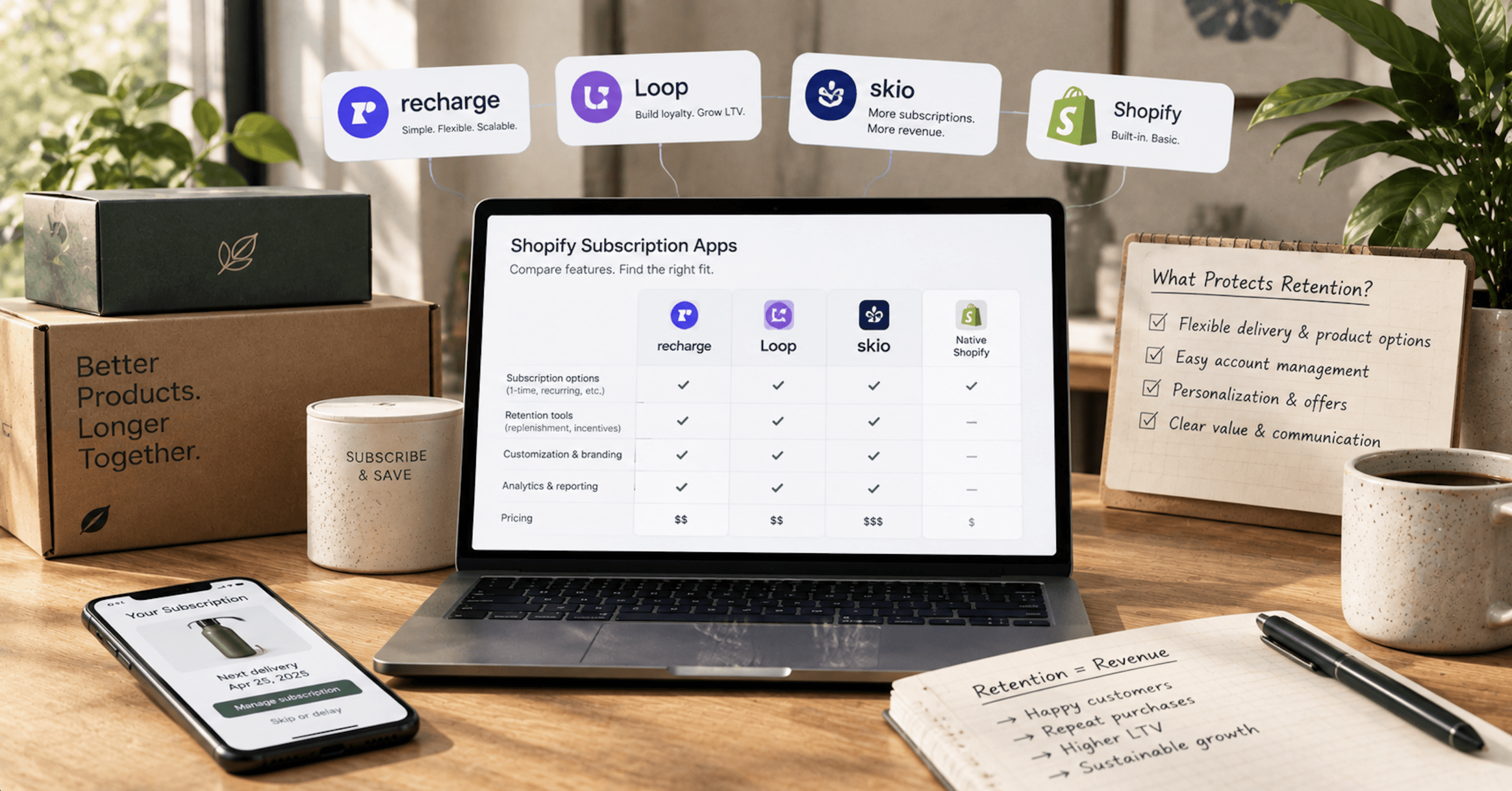
Choosing a Shopify Subscription App: Recharge, Loop, Skio, and What Protects Retention
Recharge acquired Skio in April 2026, so two of the names on your shortlist now share an owner. The best Shopify subscription app for your store comes down to two questions: what happens when a card fails, and what happens when you want to leave.
Not sure where the gap is? That's exactly what the Digital Marketing Growth Audit is for.
A free, no-obligation look at where your site can win more traffic and conversions, with a clear digital marketing roadmap to get there. Just a straight read on where your digital presence stands and where it's headed.