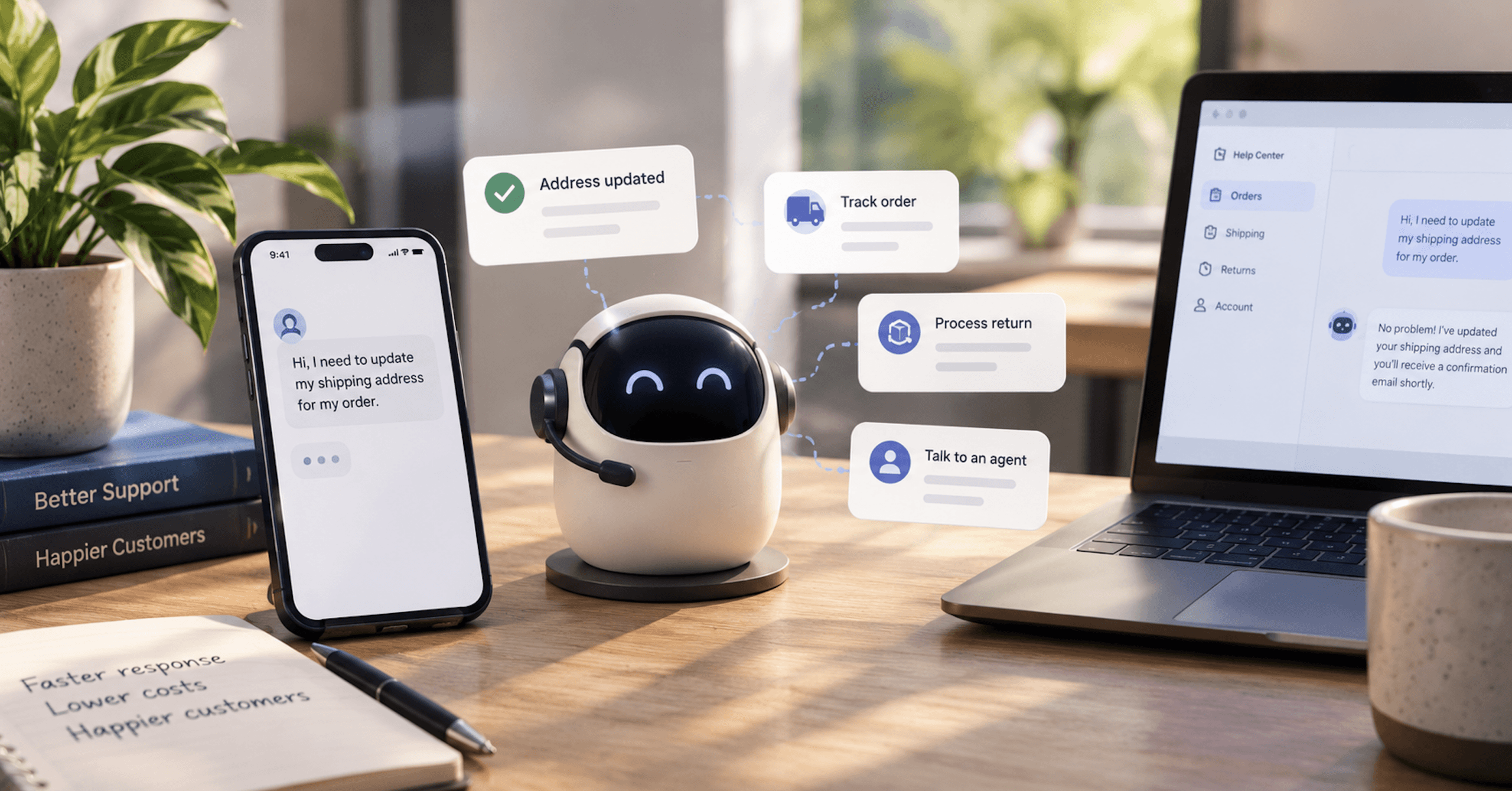
Any plan to reduce customer support costs with AI runs into the same question first. Which event does the meter fire on? The major AI support vendors bill for five different ones. When a rep says their AI resolves half your tickets, that sentence has five incompatible meanings, and only one of them describes what shows up on your invoice.
A quote of $0.99 per resolution and a quote of $0.05 per conversation are not the same kind of number, because one of them fires when a customer’s problem is solved and the other fires when a bot types a sentence. You can’t reduce customer support costs with AI if you can’t tell which of those you’re buying.
Nearly all published performance data in this category comes from companies selling the software, and vendor pricing is a moving target.
We build and run support stacks for DTC brands on Shopify, and this is the analysis we’d give a client sitting in a renewal or a replatform. If you’re choosing a platform rather than pricing one, our comparison of Gorgias and Zendesk for ecommerce teams covers fit and features.
How to Reduce Customer Support Costs With AI: Start With the Billing Unit
The billing unit is the contract. Everything else on the quote, the seat price, the included allowance, the promised resolution rate, is downstream of which event triggers a charge. Two brands with identical ticket volume and identical AI performance will get materially different bills from different vendors.
The table sets each vendor’s billable unit side by side: Zendesk’s verified resolution (opens in new tab), Intercom’s per-outcome pricing (opens in new tab) and its four Fin outcomes (opens in new tab), Gorgias’s automated interaction (opens in new tab), Help Scout’s AI resolution (opens in new tab), Tidio’s Lyro conversation (opens in new tab), Front’s Autopilot conversation (opens in new tab), Re:amaze’s resolution (opens in new tab) and Kustomer’s unpublished pricing (opens in new tab).
| Vendor | Billable unit | Charged when | Not charged when | Window | Published price |
|---|---|---|---|---|---|
| Zendesk | Verified resolution | AI answers, customer asks nothing further, and an LLM verifies the request was resolved | Assisted escalation, or a contained conversation that fails LLM verification | Email 72h after last email; messaging 2h by default, configurable to 72h; voice at hangup | $1.50 committed; $2.00 pay-as-you-go |
| Intercom (Fin) | Outcome, four types | Resolution, Procedure handoff, Disqualification or Qualification | A conversation simply passed to your team with no outcome | Not published | $0.99 for three types; $9.99 for Qualification |
| Gorgias | Automated interaction | Ticket fully handled by AI Agent, Flows, Order Management or Article Recommendations | A human takes over, in which case only the ticket fee applies | No human involvement within 72 hours | $0.90 annual, $1.00 monthly; $1.50 past the allowance |
| Help Scout | AI resolution, per chat session | AI gives a full answer and the customer doesn’t ask for more help | Greeting or partial answer, or the customer requests more help | Session-scoped, no time definition published | $0.75 |
| Tidio (Lyro) | Lyro conversation | The AI posts at least one reply | Nothing published; outcome is irrelevant to the charge | Session persists across customer returns | $0.70 to $0.78 on the published ladder |
| Front | Autopilot conversation | Not published | Not published | Not published | “Starting at $0.05” |
| Re:amaze | Resolution | AI Agent handles the whole conversation thread without escalating to a human | The conversation escalates to a human agent | One count per conversation thread; no time window published | $0.85 past allowance |
| Kustomer | Not published | Not published | Not published | Not published | Not published |
| Richpanel | AI-handled conversation | Richpanel defines it inconsistently | Not published | Not published | Richpanel publishes conflicting prices; get a written quote |
Five of these vendors charge for AI success. Two charge for AI engagement. That single split explains most of the price spread in the last column, and it’s the first thing to establish on a sales call.
Zendesk Bills Only for a Verified Resolution
Zendesk groups AI agent work into three tiers (opens in new tab), a change it dates to May 18, 2026. An Assisted escalation, where the AI collected data, authenticated the customer or routed the conversation before a human finished it, doesn’t count against your resolution allowance. Neither does a Contained resolution.
Contained is the interesting tier. The AI handled the conversation to completion, the customer never asked for clarification, never gave negative feedback, never asked for a human, and at conversation end an LLM evaluates the transcript to confirm the request was actually resolved. Conversations that fail that verification are Contained and free. Only conversations that pass it become Verified resolutions and draw down your allowance.
That’s the strictest billable definition in the market. Containment isn’t enough; a machine has to agree the customer was helped. Conversation end is defined per channel: 72 hours after the last email, two hours after the last message on messaging with the option to raise that to 72, and immediately at hangup on voice.
Zendesk’s price per automated resolution (opens in new tab) is $1.50 each for resolutions you commit to in advance and $2.00 each pay-as-you-go, on Support Team, Suite Team and Suite Professional. Confirm your committed volume and rate on a quote with your name on it.
The allowances Zendesk published for the platform prior to resolution tiers (opens in new tab) are explicitly historical: Team 5 automated resolutions per agent per month, Growth and Professional 10, Enterprise 15, with a hard cap of 10,000 allocated automated resolutions per year on all plans. On that platform, Zendesk says committed usage bought in advance gives a better per-resolution cost than pay-as-you-go overage, and that overage bills monthly regardless of your subscription term.
Zendesk lists the same included allowances by plan (opens in new tab), 5 automated resolutions per agent per month on Support Team and Suite Team and 10 on Suite Professional, capped at 10,000 a year. That listing doesn’t say whether those figures apply to the post-May-2026 tiered platform.
For email AI agents, Zendesk warns that if you haven’t created the automation trigger that detects human intervention, human replies don’t appear in the conversation logs, and automated resolutions might be consumed for conversations they shouldn’t be. That’s a billing defect caused by a configuration step.
Intercom Bills Four Outcomes, One at Ten Times the Price
Intercom’s Fin charges per outcome, once per conversation no matter how many actions it takes. There are four billable outcomes (opens in new tab): Resolution, Procedure handoff, Disqualification and Qualification. Resolutions, Procedure handoffs and Disqualifications are $0.99 each, Qualifications are $9.99 each, and a conversation simply passed to your team with no outcome isn’t charged.
A Procedure handoff bills $0.99 for a conversation that a human then takes over, because you configured that escalation as a Procedure and Fin executed it. That’s defensible pricing for automated triage, and it’s also not what you picture when you budget “per resolution.”
The $9.99 Qualification outcome is the one that moves a bill. It fires when Fin matches a prospect to qualification criteria and routes them, which is a sales path rather than a support path. A brand running Fin as a pre-purchase shopping assistant can generate ten-dollar events all day while still describing its spend as ninety-nine cents a resolution. Fin standalone carries a 50-outcome monthly minimum with no seat cost and no platform fee.
Intercom sells the same capability under two SKUs, so establish which one your quote is built on. Intercom is testing its Essential seat price (opens in new tab), so take the seat price from your quote. Both SKUs price Fin at $0.99 per outcome (opens in new tab). Copilot is $29 per agent per month on annual billing and $35 on monthly.
Gorgias Bills Twice for One Fully Automated Ticket
Gorgias defines an automated interaction (opens in new tab) as a customer issue fully handled by AI Agent or another automation feature, with a clean time test: an interaction counts as automated if the customer doesn’t require a human within 72 hours. Hand off to a person and only the ticket fee applies.
Resolve it entirely with AI and both fees apply. An outcome-based automation fee lands on top of the ticket fee, and one ticket can count toward your usage for both helpdesk tickets and automated interactions. Accounts on legacy pricing are counted one way or the other, not both. So on current pricing, the most successful outcome the AI can produce is also the most expensive ticket in your account.
Three of the six billing scenarios Gorgias works through are a customer using the chat widget’s self-service path, reading a Flow, an Order Management response or a recommended article such as “What size should I order?”, then clicking “Yes, that was helpful.” That’s a real deflection and it saves real agent time. It’s also a thumbs-up on a help article, not an AI conversation, and it bills as an automated interaction, though with the automation fee only, since the double charge applies only when AI Agent resolves the ticket.
Gorgias has two rates, and the difference between them is the thing to understand before you sign. AI Agent interactions cost $0.90 each on annual plans and $1.00 on monthly plans (opens in new tab), and anything past the plan’s included allowance is billed at $1.50 per interaction. So the included rate and the overage rate are roughly $0.90 and $1.50, and a brand that outgrows its allowance is paying about 67 percent more per interaction than the rate it signed on.
Gorgias lists per-interaction rates of $1.00, $0.90, $0.90 and $0.85 across Starter, Basic, Pro and Advanced, which fits the annual-versus-monthly split, since Starter is monthly billing only. One rate doesn’t reconcile. Dividing the published AI Agent component by the published allowance gives $1.00 on Starter, $0.90 on Basic and $0.90 on Pro, all matching the listed rates, but $0.90 on Advanced where Gorgias lists $0.85. Ask about that one on the call.
Help Scout Bills the Chat Session at $0.75
Help Scout’s definition is the plainest of the five. Help Scout defines a resolution (opens in new tab) as a single AI chat session resolved without help from a human, charged once per session when AI Answers provides a response and the customer doesn’t ask for additional help after the last AI response. You’re not charged when the AI only greets the customer or asks a follow-up without giving a full answer, and you’re not charged when the customer asks for more help.
No LLM verifier sits behind that. The test is behavioral: the customer stopped asking. It’s a looser bar than Zendesk’s and a cheaper unit at $0.75 per resolution (opens in new tab), which is a coherent trade rather than a trick.
Three operational details change the cash timing. AI resolutions bill in arrears rather than in advance like the rest of Help Scout’s charges. You can set a monthly spending limit expressed in resolutions, and when you hit it AI Answers switches off in your Beacon until the next cycle or until you raise it. New Help Scout customers get a free three-month trial to train the AI, and existing customers who switch it on get no trial period at all.
Help Scout also gives you an auditable trail, which not every vendor here does. Go to Tools, then Beacons, then the Sessions tab, where a Resolutions filter shows exactly which sessions were billable. Ask every vendor on your shortlist for that screen before you sign.
Tidio and Front Bill for AI Replies, Not Resolutions
Tidio defines a Lyro conversation (opens in new tab) as a customer interaction on any connected channel that has at least one reply from the AI agent, and a dozen replies or a customer leaving and returning later still count as a single conversation. Outcome plays no part in that definition. A conversation where Lyro answers badly, the shopper gets frustrated, and a human cleans it up bills the same as one Lyro solved outright.
Tidio’s published ladder runs from $39 a month for 50 Lyro conversations (opens in new tab) to $700 a month for 1,000, which works out to $0.78 down to $0.70 per conversation. Tidio also publishes a separate, cheaper ladder for Latin America, so check which one you’re being quoted. Tidio advertises Lyro at “just $0.5 per conversation,” and no published self-serve tier reaches it, so budget from the ladder rather than the headline.
Tidio’s Premium tier sells “Pay-per-resolution billing” and a “Guaranteed 50% Lyro AI resolution rate” as line-item upgrades, which tells you precisely what the standard model doesn’t bill on. If pay-per-resolution is the premium, engagement is the default.
Front sits in the same category with less published detail. Front lists Autopilot (opens in new tab) at “Starting at $0.05 /conversation” alongside seats at $25, $65 and $105 per month on annual billing. Front’s pricing doesn’t define an Autopilot conversation, and no price ladder above the starting figure is published, so the cheapest-looking unit in this market is also the least defined one.
What Those Five Definitions Do to Your AI Customer Support Costs
Take one concrete scenario. A shopper asks where an order is, the AI answers with a tracking link, and the shopper never writes back. Under Gorgias that’s an automated interaction after 72 hours and it carries both a ticket fee and an automation fee.
Under Help Scout it’s a $0.75 resolution. Under Tidio it billed the moment the AI replied. Under Zendesk it bills only if an LLM reviewing the transcript agrees the customer was actually helped, and it’s free if that check fails.
Change one detail, that the shopper replies “that’s not my order,” and the outcomes diverge again. Gorgias charges only the ticket fee once a human steps in.
Intercom charges nothing for a plain handoff and $0.99 if you built that escalation as a Procedure. Tidio still charges. Zendesk logs an Assisted escalation and charges nothing.
None of this is deceptive. All five vendors publish their definitions, and the honest reading is that they’re pricing different products. It does mean a spreadsheet comparing per-unit prices across vendors is comparing five different things, and the way to reduce customer support costs with AI is to compare the events, then the prices, in that order.
Four questions settle it on a call, and the answers should come from a vendor’s published documentation rather than a rep’s recollection:
- Does the meter fire on the AI's first reply, or on a confirmed outcome?
- Is an escalation to a human ever billable, and under what configuration?
- Can a single ticket carry more than one charge?
- Who verifies that the customer was helped, and where can I audit the billable conversations myself?
AI Help Desk Pricing and the Real Cost of Customer Support Automation
Seat and plan prices are the easy half, and most of this market publishes them: Gorgias (opens in new tab), Zendesk (opens in new tab), Intercom (opens in new tab), Help Scout (opens in new tab), Re:amaze (opens in new tab), Front (opens in new tab), Tidio (opens in new tab) and Richpanel (opens in new tab). Annual figures are shown per month where the vendor quotes them that way.
| Vendor | Entry | Mid | Top self-serve | What the plan meters | AI charge |
|---|---|---|---|---|---|
| Gorgias | Starter $40/mo, 50 tickets, 3 seats | Pro $471/mo annual, 2,000 tickets | Advanced $1,227/mo annual, 5,000 tickets | Tickets, not seats (500 seats from Basic) | $0.90 annual, $1.00 monthly; $1.50 past allowance |
| Zendesk | Support Team $19/agent/mo annual (5 included automated resolutions/agent/mo) | Suite Team $55/agent/mo annual | Suite Professional $115/agent/mo annual | Agents | $1.50 committed or $2.00 pay-as-you-go per resolution |
| Intercom | Essential: seat price under test, confirm on quote | Advanced $85/seat/mo annual | Expert $132/seat/mo annual | Full seats, with free Lite seats above Essential | $0.99 or $9.99 per outcome |
| Help Scout | Free, then Standard $25/user/mo annual | Plus $45/user/mo annual | Pro $75/user/mo annual, 10-user minimum | Users, plus contacts | $0.75 per resolution |
| Re:amaze | Basic $26.10/user/mo annual | Pro $44.10/user/mo annual | Plus $62.10/user/mo annual | Team members; AI allowance scales with seats | $0.85 past allowance |
| Front | Starter $25/seat/mo, single channel | Professional $65/seat/mo | Enterprise $105/seat/mo | Seats | Autopilot from $0.05 per conversation |
| Tidio | Free at 50 conversations | $89/mo at 400 human conversations | $349/mo at 2,000 human conversations | Conversations, human and AI billed separately | $39/mo for 50 Lyro conversations, up |
| Kustomer | Not published | Not published | Not published | Not published | Not published |
Kustomer publishes no prices at all (opens in new tab). In their place is a two-minute assessment that promises to estimate your annual cost savings, ROI and payback period before connecting you with someone who can build out exact pricing, and its feature grid shows bare dollar-sign placeholders where numbers would go. The one pricing statement Kustomer makes there is that Kustomer Voice and WhatsApp are pay as you go.
Re:amaze does something structurally odd that changes the math for small teams. Its AI allowance scales with seats rather than with ticket volume: 5 included resolutions per user per month on Basic, 10 on Pro, 20 on Plus, with $0.85 for each additional one. A three-person team on Pro gets 30 included AI resolutions a month no matter how many tickets it receives.
Richpanel has listed different help desk seat plans (opens in new tab) and different prices per AI-handled conversation in different places on its own site. If Richpanel is on your list, get the seat price and the AI billing unit in a written quote.
On Gorgias, actions such as cancel, discount and apply, along with brand voice and guardrails, aren’t available on Starter, so the entry tier gives you an AI that can answer but cannot act. Magento support starts at Pro, which means a brand on Adobe Commerce is looking at a $471 monthly entry point rather than the $77 Basic plan.
Build the Cost Per Ticket You Need Before You Reduce Customer Support Costs With AI
Every ROI conversation in this category runs through a cost-per-ticket number. Build your own. It takes four inputs, two of which come from the US government and two of which come from your own help desk.
The wage input is the Bureau of Labor Statistics median pay for customer service representatives (opens in new tab), which was $21.53 per hour and $44,770 per year in May 2025, with the bottom 10 percent under $15.27 an hour and the top 10 percent over $30.57. The benefits load comes from BLS employer costs for employee compensation (opens in new tab) for March 2026, where private-industry total compensation runs $46.60 an hour, of which wages and salaries are $32.60, or 69.9 percent.
Divide the median wage by that wage share and you get the loaded hourly cost of one US agent: $21.53 divided by 0.699 is $30.80 per hour. That’s our arithmetic combining two BLS figures, not a BLS-published number. BLS doesn’t print a wage share for civilian workers, but dividing its published civilian figures gives $33.72 of $49.32, or 68.4 percent, which works out to $31.49 an hour instead. Either is defensible as long as you say which one you used.
The second input is tickets resolved per productive hour, and it isn’t a government statistic. Pull it from your own help desk reporting, because it’s the single biggest lever in the calculation and the one number nobody can supply for you. Here’s what it does at $30.80 loaded, before and after the correction almost no vendor calculator applies.
| Tickets resolved per productive hour | Cost per ticket at $30.80/hr loaded | Corrected for 75% occupancy |
|---|---|---|
| 3 | $10.27 | $13.69 |
| 4 | $7.70 | $10.27 |
| 6 | $5.13 | $6.84 |
| 8 | $3.85 | $5.13 |
| 10 | $3.08 | $4.11 |
| 12 | $2.57 | $3.42 |
The occupancy correction is the third column and it’s the step that separates a real number from a flattering one. Paid hours aren’t ticket hours: training, breaks, meetings, QA reviews, idle time between contacts and admin all sit inside the hour you paid for. If your agents spend 75 percent of paid time actually handling contacts, divide tickets per hour by 0.75, which is the same as multiplying cost per ticket by 1.33, so six tickets an hour costs $6.84 rather than $5.13.
Now compare that to the AI unit price rather than to zero. A fully loaded human ticket in the range of $5 to $7 against published AI units of $0.75 to $1.50 is a 3x to 9x gap depending on which end of each range you land on, which is a strong business case. The framing that AI reduces customer support costs to nothing is the one that gets brands in trouble, because the AI unit price applies only to the tickets the AI actually closes.
The fourth input is volume. Gorgias Ecom Lab reported in April 2026, from Gorgias platform data at the $10M GMV band, that an Electronics brand generates about 46 support tickets for every 100 orders (opens in new tab) while a Food and Beverages brand generates about 20. Same GMV band, more than twice the support load, driven by product complexity rather than by anyone doing a bad job.
Published figures for the share of tickets that are order-status questions span roughly 18 to 60 percent. Your help desk can tell you the real answer from your own tags in about ten minutes, and that answer is the only one that should touch your model. The same Gorgias research found that first response time varies 5.5x across 14 verticals at the same GMV while CSAT varies 0.2 points and resolution time 1.5x, so borrowed averages describe almost nobody.
Returns are usually the second-largest driver behind order status, and they’re the category where automation pays or fails on process design rather than on model quality. We’ve written separately about building a returns process on Shopify that doesn’t generate tickets in the first place, which is the cheaper end of the same problem.
Why Vendor ROI Models Overstate How Much AI Reduces Customer Support Costs
Gorgias publishes its ROI methodology, which is more than most vendors do, and the assumption inside it is the reason you can’t use its output directly. Gorgias’s ROI assumes a $20,000 blended annual cost per agent (opens in new tab), weighted across US-based and offshore support hires, plus $9,000 average annual platform cost. BLS puts the median US customer service representative’s wage alone at $44,770 a year, before any benefits load.
Gorgias reports $73,000 in net annual savings at its lowest automation tier after platform costs, and that number is computed against an agent who costs $20,000 all in. A US-staffed DTC brand reading that figure is reading a result generated for a cost base roughly twice its own on wages alone, which cuts in both directions depending on where your team sits.
Gorgias states the assumption plainly and labels it as offshore-weighted, which is exactly what you need in order to substitute your own inputs. The number you act on has to be built from your payroll rather than borrowed from a vendor’s model.
The rest of the published deflection claims need the same treatment. Help Scout asserts in its pricing calculator that the average resolution rate is 73 percent, with no sample, method or date attached. Zendesk promises resolution of “up to 80%+” of complex service issues, and elsewhere attaches that same 80-percent-plus figure to AI Expert, a paid subscription service rather than the product itself.
Tidio contradicts itself usefully. Its marketing says customers average a 75 percent resolution rate with Lyro, while the Premium tier line item it’s willing to put in a contract reads “Guaranteed 50% Lyro AI resolution rate.” When a vendor’s marketing average and its contractual guarantee differ by 25 points, the guarantee is the number to plan against.
AI Ticket Deflection Versus Resolution, and Which One Cuts Customer Support Costs
The vendors have quietly stopped saying “deflection.” Zendesk says automated resolution, Intercom says outcome, Gorgias says automated interaction, Help Scout says resolution, and none of them publishes a definition of a deflection rate. The shift is more than branding: deflection describes making a ticket go away, and resolution describes solving a problem, and only one of those two survives contact with a customer who still needs an answer.
Gorgias Ecom Lab defines the metric the way we’d define it. In its April 2026 research on AI handoffs, AI Resolution Rate (opens in new tab) is the share of AI-touched tickets closed without a human agent message, measured across Gorgias merchants from October 2025 through April 2026, on accounts with at least 200 AI-touched tickets in the window.
Across that platform data the median brand resolves 45 percent of AI-touched tickets end to end and the top quartile clears 65 percent. That’s a vendor publishing a mediocre median for its own customers, and it’s more useful than any “up to 80 percent” claim in this market precisely because it’s unflattering. Model your business case at 45 percent and treat 65 as the reward for doing the implementation work well.
That number sets the ceiling on savings. If AI touches every ticket and resolves 45 percent of them, you’re paying an AI unit price on 45 percent of volume and a human cost on the other 55 percent, plus the platform ticket fee on both. AI reduces customer support costs on the tickets it closes and adds a line item to the tickets it doesn’t.
Gorgias also publishes what separates the top quartile, and all four traits are configuration decisions rather than model quality: broader intent coverage across the full top-20 intent list rather than the easiest five to eight, action authority to issue refunds and modify subscriptions within guardrails, deep system integrations so the AI can act rather than answer, and a narrow escalation policy that reserves humans for judgment calls instead of lookups.
What Customer Service Automation Can Take Off Your Support Cost Line
The ticket categories these vendors say their AI handles are all order-shaped: order status and tracking, returns and RMA, order cancellation, order edits before fulfillment, refunds, shipping address updates, subscription changes, sizing and fit questions, and discount codes. Gorgias describes its AI Agent’s actions (opens in new tab) as including canceling an order, processing a return and updating a shipping address, all opt-in and configurable per action and condition.
Access is the gate, not intelligence. Gorgias says its AI Agent (opens in new tab) pulls storefront details, order history, product catalogs, inventory levels and customer tags from platforms like Shopify, then acts across those systems by editing subscriptions, issuing refunds and updating shipping details. An AI with read-only access to your help center can answer policy questions, and DTC tickets are overwhelmingly about one specific order.
Gorgias’s own research states the consequence in one line: “Brands that route every action to a human cap their resolution rate by design.” That’s a vendor arguing its own book, and it also matches the mechanics. If the AI can’t issue the refund, the best it can do is describe the refund policy and create a handoff.
Whether the AI can take actions in your returns, subscription or 3PL platform, whether that’s Loop, Recharge, AfterShip or whatever sits in your stack, is a sales-call question. Ask by app name and ask for a demo of the write action, not the read.
Customer data quality feeds this too, since an AI answering an order question is only as good as the order and profile data it can reach. The same discipline that makes purchase history usable in a Klaviyo setup is what makes an AI agent able to answer “where’s my second subscription shipment” without escalating.
What Customer Support Automation Still Sends to a Human, and What That Costs
Gorgias names three handover triggers: the AI hands off when it can’t confidently respond, when it encounters a sensitive topic, or when it detects frustration from the shopper. Zendesk says its AI agents route escalations to the right team with full context. Intercom prices a Procedure handoff as a billable outcome, which is a vendor treating escalation as a designed result rather than a failure.
Gorgias Ecom Lab calls the residual an escalation budget, the share of tickets that genuinely need human judgment, authority or empathy, and puts it at maybe 20 to 30 percent of total volume for most ecommerce brands. That figure comes from a vendor whose commercial interest is in a smaller number, which is a point in its favor. Plan your staffing against it rather than against a headcount reduction the software promised.
Gorgias’s own platform data also reports that nearly one in four brands, 23.5 percent, reduced their team after enabling AI Agent, and that of those, 51 percent achieved fewer people with the same ticket volume and the same or more revenue. Roughly half the brands that cut headcount didn’t hold all three. Those figures come from Gorgias’s own merchant data with a stated methodology and a $20,000 agent cost assumption behind the dollar conversions.
The Abandoned Handoff That Erases Your AI Customer Support Cost Savings
Gorgias Ecom Lab reports that 55 percent of AI-touched support tickets end in a human handoff, that the median shopper waits 10 hours the moment a ticket crosses to a human, and that 33 percent of handed-off tickets are abandoned and never receive a human response at all.
A third of your escalations never getting answered is a worse customer outcome than having no automation at all. Without AI, that shopper waits in a queue and eventually hears from someone. With a badly run handoff queue, they get a fast machine answer that didn’t work, then silence. You converted “slow” into “never,” and you paid a platform fee for the privilege.
Gorgias reports that contact form handoffs resolve 36 hours after handoff and abandon 42 percent of the time, email handoffs resolve in 32 hours and abandon 30 percent, and chat resolves in 8 hours and abandons 13 percent. Gorgias attributes the chat figure to the pressure of a live channel, which matches what anyone who has staffed one would expect. If your AI’s escalation path dumps into a contact form inbox nobody owns, that’s where your CSAT goes.
The same research puts the worst operators at 87-hour resolution times with a CSAT of 4.10 against 4.45 at the top, roughly 522 times slower than AI closing the same ticket end to end. It also reports that the tickets AI finishes on its own close within minutes, are never abandoned, and score about the same on CSAT as human-resolved tickets in the same intent categories. The damage sits in the handoff, not in the AI’s answer.
Gorgias defines the metric that catches this before your customers do. Dead time is the elapsed time between the last AI agent message and the first human agent reply, and abandonment is a handed-off ticket with no subsequent human agent message. Put both on a weekly report the day you turn AI on, and set an alert threshold before you touch headcount.
In Gorgias’s reporting, auto-reply rules don’t affect first response time (opens in new tab), so you can’t flatter your own FRT with an autoresponder. Resolution time runs from the customer’s first message to the last time the ticket was closed.
What You're Liable For When Your AI Speaks for Your Brand
There’s one real precedent and it’s Canadian. In Moffatt v. Air Canada, 2024 BCCRT 149, decided February 2024, the British Columbia Civil Resolution Tribunal held Air Canada responsible (opens in new tab) for incorrect information its website chatbot gave a passenger about bereavement fares. The airline argued the chatbot was effectively a separate entity responsible for its own statements, the tribunal rejected that, and it found negligent misrepresentation and ordered CAD $812.02 in damages, interest and fees.
The award is small and the mechanism is generic. An AI agent that invents a returns window, a discount eligibility rule, a shipping guarantee or a warranty term is making a representation on your behalf, and “the bot said it” wasn’t a defense there. This is an operational question about what your AI is permitted to assert about policy and how tightly you constrain it, not legal advice, and the constraint lives in your guardrail configuration.
The clearest statement from a US regulator on the operating principle comes from the Consumer Financial Protection Bureau’s 2023 report on chatbots in consumer finance (opens in new tab):
Deficient chatbots that prevent access to live, human support can lead to law violations, diminished service, and other harms.
That report covers consumer finance and the CFPB has no jurisdiction over a DTC apparel brand, so treat it as an operating principle rather than as law that applies to you. The principle transfers cleanly: blocking the path to a human is itself the risk. Design a visible, one-click route to a person and staff it.
The FTC’s Operation AI Comply (opens in new tab) sweep from September 2024 targeted deceptive claims about AI products and AI-enabled business schemes, and none of the five actions concerned a support agent making a false statement to a customer, so it isn’t chatbot guidance.
If you ship to the EU, one obligation is already live. Article 50(1) of the EU AI Act (opens in new tab) took effect on 2 August 2026 and requires providers of AI systems intended to interact directly with people to design them so those people are informed they’re interacting with an AI system, unless that’s obvious to a reasonably well-informed, observant and circumspect person in the context. In practice that’s a disclosure in your widget and in your automated email replies, and it’s cheap to do now and awkward to retrofit.
When AI Reduces Customer Support Costs, and When It Doesn't
Can AI reduce your customer support costs? Yes, and the honest size of it is a 3x to 9x per-unit gap applied to somewhere near 45 percent of AI-touched volume, not the 80 percent on the marketing page. At a loaded $6.84 per human ticket and roughly $0.90 per automated interaction, a brand doing 2,000 tickets a month that resolves 45 percent of them with AI is trading about 900 human tickets for about 900 AI units, and the arithmetic on your own inputs is the only version of that sentence that matters.
The conditions where this math works are specific. You need enough monthly volume that per-unit AI pricing beats a block of fixed human capacity. You need action authority wired into your order, returns and subscription systems, since an AI that can only answer caps its own resolution rate. And you need a staffed handoff queue with dead time on a weekly report, because a 33 percent abandonment rate on escalations will cost you more in repeat purchase than the automation saves.
The conditions where it doesn’t work are just as specific. Entry tiers that exclude actions give you an FAQ bot at a resolution price. Very low volume means the platform subscription dominates and the AI unit price is rounding.
A ticket mix weighted toward high-value orders, complex complaints and judgment calls sits inside the 20 to 30 percent escalation budget by nature, and no configuration moves it. And cutting headcount before you’ve measured your resolution rate for a full quarter converts a savings plan into a service outage.
The one strong independent study in this area measures something adjacent, and its finding is useful anyway. Brynjolfsson, Li and Raymond’s “Generative AI at Work,” (opens in new tab) published in the Quarterly Journal of Economics in May 2025, studied 5,172 customer support agents and found access to a generative AI assistant increased issues resolved per hour by 15 percent on average.
The gain wasn’t uniform: less experienced and lower-skilled workers improved both the speed and the quality of their output, while the most experienced and highest-skilled saw small gains in speed and small declines in quality. That’s AI assisting humans rather than replacing them, in a single firm outside DTC, so it isn’t evidence about autonomous deflection.
Read it as a staffing finding instead. If your seasonal hiring doubles your team every Q4 with people who’ve never seen your returns policy, the published gain concentrated in novices is where your realistic first-year return lives. That’s a copilot deployment, and it’s easier to run safely than autonomous resolution.
BLS projects employment of customer service representatives to decline 5 percent from 2025 to 2035, a loss of 141,800 jobs from a base of 2,666,000, while still averaging about 289,500 openings a year over the decade from replacement need. The occupation is shrinking and it isn’t disappearing, which is roughly what a 45 percent median resolution rate would predict.
This technology reduces customer support costs for DTC brands that give it write access to order systems and staff the escalation path, and it quietly raises costs for brands that buy it as a deflection layer on an entry tier and stop looking. Model at the median, hold the vendor to a published definition of what it bills for, and measure dead time from week one.
Reduce Customer Support Costs With AI, Starting From Your Own Numbers
You don’t need another benchmark. You need your tickets per 100 orders, your tickets per productive hour, your occupancy rate, your escalation mix, and a vendor quote that names the event it charges for. Four of those five live in systems you already own.
If you want a second set of eyes on that math before a renewal or a migration, that’s what our free Growth Audit is for. A clear look at where your support volume comes from, what it’s costing you per resolved ticket, and whether automation actually moves that number in your stack.
See how we build Shopify automations like this and we’ll run the numbers with you.

Shopify B2B Payments in 2026: Net Terms, ACH, and What Shopify Will Never Underwrite
Shopify moved ACH, net terms and vaulted cards off Plus in April 2026, so the B2B payments question isn’t a plan question anymore. It’s a risk question, and Shopify doesn’t answer that one.

Shopify Black Friday 2026: The 82-Day Readiness Checklist
Black Friday 2026 is Friday, November 27, and Cyber Monday lands in November, not December. Here’s the 12-week Shopify readiness sequence, starting with the two platform deadlines that already passed.

Product Feed Optimization for AI Search: What Structured Data Actually Does
Google says structured data isn’t required for generative AI search. It’s still required for the feed that reaches AI Mode. Here’s the chain, and what Shopify leaves out of the box.
Not sure where the gap is? That's exactly what the Digital Marketing Growth Audit is for.
A free, no-obligation look at where your site can win more traffic and conversions, with a clear digital marketing roadmap to get there. Just a straight read on where your digital presence stands and where it's headed.