Type a product title and two keywords into an AI product description generator and you’ll get clean, confident copy back in a few seconds. Tone won’t be the problem. The problem is the sentence in the third paragraph that says the strap is full-grain leather when your spec sheet says it’s bonded.
That sentence is a returns problem, a chargeback problem and potentially an FTC problem. It becomes a ranking problem last, if it ever does. So the value in AI product descriptions sits almost entirely in what happens after the generate button, not before it.
Every rule, number and quotation below links to the primary source it came from. Shopify’s help center and Google’s documentation are vendor documents about their own products, and they’re labeled that way in the sentence where they appear. The FTC pages are the regulator’s own published guidance.
We build and rebuild Shopify catalogs, so what follows is the generation workflow and the review gate we’d hand a client who’s about to run a generator across a few thousand SKUs.
Shopify's Own Docs Say AI Product Descriptions Can Invent Facts
Shopify Magic is the AI writing feature built into the admin. Shopify describes it as a suite of free AI-powered features available regardless of subscription plan, with product descriptions as one of the surfaces where it generates text (Shopify’s own documentation). Shopify says the text generation relies on large language models, and its documentation doesn’t name which ones.
The help center page for the product description feature carries this caution.
You're responsible for the accuracy of all of the content that you publish to your store, even when you use automatic text generation to create it. Generated text can include things such as product benefits even when you didn't list any explicitly, and facts based on other published content related to similar products. It's important that you read all generated content closely to ensure accuracy before publishing.
That’s the vendor, in its own feature documentation, describing two separate failure modes (Shopify, Automatically generating product descriptions). The first is invention: benefits that appear because persuasive copy has benefits, not because you supplied any. The second is contamination: facts drawn from other published content about similar products.
Contamination is the harder one to catch. A wrong benefit reads as marketing, and a reviewer discounts it automatically. A wrong compatibility line borrowed from a similar SKU reads as a specification, and a customer will treat it as one.
Shopify’s best practices page for its AI tools says the same thing in a flatter register: “Because these tools use AI, the same request won’t always produce the same result.” The page closes by saying that following its practices helps you get better results, “but AI tools are still evolving and can make mistakes” (Shopify).
Non-determinism is why a one-time review of the prompt isn’t a review of the output. You can read the result for SKU 1, approve the prompt, and get a differently shaped result on SKU 200 from the same instruction. The gate runs per product, not per prompt.
There’s also a gap between how Shopify describes AI review in general and how this specific flow behaves. The best practices page says AI tools present changes for your review before applying them. The product description steps say the generated text is applied directly to the product description, so the copy lands in the live field you were editing and the review is yours to impose.
Google's Line On AI Product Descriptions Is Purpose, Not Production Method
Google’s spam policies name scaled content abuse, and no policy on the page is named for AI (Google Search spam policies). AI shows up only in an example, using generative AI tools to generate many pages without adding value for users, where the operative words are the last five. The test is whether many pages got generated to manipulate rankings rather than to help users, and it catches thin copy produced at scale by humans just as readily. We’ve set out how that policy works, what it replaced in March 2024, and what recovery involves, in why rankings drop.
So the question a review answers isn’t whether a machine wrote it. Google’s 2023 guidance is blunt about the ceiling: “Using AI doesn’t give content any special gains. It’s just content” (Google Search’s guidance about AI-generated content).
Scaled content abuse is an enumerated basis for a manual action, not only an algorithmic consideration. Google’s Manual Actions report describes the Major spam problems action as a site that “appears to use aggressive spam techniques such as scaled content abuse, cloaking, and/or other repeated or egregious violations of Google’s spam policies” (Search Console Help). No site has been publicly identified as penalized specifically for scaled AI content, and Google doesn’t publish case files.
Do you have to disclose that a description was written with AI? Google’s guidance on generative AI content says that if you’re automatically generating content, you should consider adding information on how it was created in a way that makes sense for your audience (Google). Its 2023 FAQ puts the same point as a judgment call, saying disclosures are useful where someone might think “How was this created?”, and adds that giving AI an author byline is probably not the best way to make that clear (Google). Neither statement makes a storefront disclosure mandatory. The one hard labeling requirement in this topic lives in the product feed, covered further down.
Where An AI Product Description Generator Earns Its Place
The realistic alternative to a generated description usually isn’t a hand-written one. It’s the manufacturer’s copy, pasted from a supplier sheet, sitting identically on every retailer that carries the item.
Google’s position on that is old and still hosted. A 2008 Search Central post, which cites the long-retired Webmaster Guidelines, says “There’s no such thing as a ‘duplicate content penalty.’” The same post makes the commerce point directly, asking of Amazon affiliates, “how the heck are they going to outrank Amazon if they’re providing the exact same listing?” (Google, 2008).
The current spam policies carry the sharper version under scraping: “Republishing content from other sites without adding any original content or value, or even citing the original source.” Syndicated manufacturer copy isn’t a penalty. It’s a page with no argument for being selected over the fifty others carrying the identical paragraph.
That’s the job a product description generator is actually good at: turning specifications you own into original copy at a pace a two-person merchandising team can sustain. An SEO product description earns its position by saying something the supplier sheet doesn’t.
The canonical tag doesn’t solve this. rel="canonical" handles duplicate URLs inside your own site, and it has nothing to do with copy you share with fifty other retailers.
What should a product description include? Shopify’s own guidance names product specifications such as size, material and weight, suggested uses, benefits with evidence, and engaging details like stories about the product (Shopify). Its writing page is harder on generic copy, saying that vague phrasing like excellent product quality tells a customer nothing substantial and may make them skeptical when you don’t provide evidence.
How long should a product description be? Google says it has no preferred word count, in those words: its helpful content page asks whether you’re writing to a particular word count because you’ve heard Google has a preferred one, and answers “(No, we don’t.)” (Google). One of Shopify’s own example prompts asks for a description in 40 words or less. Length follows the spec sheet, so a technical component needs more room than a candle.
A Wrong Attribute Costs You A Return Before It Costs You A Ranking
Shopify names five metrics for judging whether a description works: “conversion rate,” “cart abandonment,” “return rate,” “support inquiries” and “organic search rankings” (Shopify, Writing engaging product descriptions). Two of those five are post-purchase, and they’re the two an inaccurate attribute moves first.
The mechanism is simple. A hallucinated dimension means the item doesn’t fit the space it was bought for. A wrong compatibility statement means it doesn’t work with the thing the customer already owns. Both produce a return, a support ticket and sometimes a chargeback, weeks before anything moves in Search Console.
We couldn’t find a primary source that quantifies returns caused specifically by inaccurate product descriptions, so there’s no figure here to anchor it. Shopify putting return rate on its own list supports the mechanism without sizing it. Anyone quoting you a percentage for this should be asked what the study actually measured.
The FTC Rules That Reach Generated Product Copy
US advertising law doesn’t care which tool wrote the sentence. The FTC’s small business advertising guide says an advertiser needs evidence before the ad runs: “Before a company runs an ad, it has to have a ‘reasonable basis’ for the claims” (FTC).
The reach extends past what the copy literally says. The FTC evaluates express and implied claims, and its guide states that “advertisers must have proof to back up express and implied claims that consumers take from an ad.” A generator writes implied claims constantly, because implied claims are what persuasive copy is made of.
Claims material to a purchase decision get the scrutiny, and the FTC describes material claims as representations about a product’s performance, features, safety, price or effectiveness. Health and safety claims need what the FTC calls “competent and reliable scientific evidence.” Customer praise doesn’t substitute for it: the FTC says statements from satisfied customers usually aren’t sufficient to support a health or safety claim or any other claim requiring objective evaluation.
Country of origin carries civil penalties rather than just risk. The FTC’s Made in USA guidance describes the traditional “all or virtually all” standard, and says the 2021 Made in USA Labeling Rule at 16 CFR Part 323 means “Marketers are now subject to civil penalties if they use an unqualified Made in USA label on a product that is not ‘all or virtually all’ made in the U.S., including in catalogs or online” (FTC).
A Made in USA claim can be express or implied, per that same page, and it applies to online marketing. Proudly made in America is exactly the warm filler phrase a generator adds unprompted. The FTC notes that the publication is staff’s view of the law’s requirements and isn’t binding on the Commission.
Apparel picks up a separate obligation. The FTC’s advertising guide says mail order catalogs and websites must disclose whether the fabric was imported or made in the United States. That’s a field on the spec sheet, not something to expect a generator to supply.
Ask a generator for persuasive copy and it will sometimes hand back a line shaped like a customer quote. The FTC’s final rule on fake reviews and testimonials, announced August 14, 2024, covers reviews and testimonials that misrepresent being written by someone who doesn’t exist, and the FTC’s own subhead names AI-generated fake reviews (FTC). Per that announcement, the rule takes effect 60 days after publication in the Federal Register.
The Workflow For Writing AI Product Descriptions
The workflow is four steps and a gate. The order matters, because three of the four steps exist to make the gate cheap to run.
None of it depends on the tool. Shopify Magic is the default here because it’s free and already sitting in the product form, but a spec sheet, a constrained prompt and a diff work the same against any AI product description generator.
Step 1: Build The Spec Sheet Behind Every AI Product Description
The spec sheet is a structured record per SKU, owned by someone who can be held to it: merchandising, product development, or the supplier. It exists before generation, because it’s the thing the gate diffs against. Building it afterward turns the gate into a second opinion instead of a check.
Shopify’s documented minimum input is a product title plus at least two product features or keyword items, and its docs say more keywords and phrases produce more accurate and unique generated content. That’s the vendor documenting what title-only generation costs you. Feed it the whole record rather than the minimum.
Shopify’s docs also say specific details you provide about materials, production method, fit and intended use can be turned into paragraphs in the generated description. Every attribute you supply is one the model has no reason to reach for elsewhere.
- Materials and finishes, including composite or coated substitutes
- Dimensions, weight and capacity, with the unit written out
- Size and fit, graded, plus the fit model's measurements if you shoot on one
- Production method and assembly location
- Country of origin for the product, and for the fabric where apparel rules apply
- Compatibility, meaning the tested list rather than the category
- Included accessories, and what's sold separately
- Care and cleaning instructions
- Certifications and ratings, with the certificate or test report on file
- Warranty terms and duration
Step 2: Prompt With Specs, Not Adjectives
Shopify’s documented steps say you can include product features, keywords, desired tone or any other instructions directly in the prompt. So the prompt is where the spec sheet goes, in full, rather than a summary of it.
Name the product type explicitly. Shopify’s docs flag that a title which doesn’t say what the thing is produces lower quality results, using their example of a product called Washington with no mention of eyeglasses anywhere in the title.
Shopify’s best practices page lists the tones it can write in: Expert, Playful, Sophisticated, Persuasive and Supportive. We prompt for the specification-led register and supply the evidence for any benefit we want stated, because an unsupported benefit is the exact sentence the gate deletes later.
Add an instruction to state only the attributes you supplied. Shopify’s documentation doesn’t record any guarantee that a prompt constraint gets honored, which is why the gate sits downstream of the prompt rather than inside it. A length constraint is the one instruction you can verify by counting.
Step 3: Generate AI Product Descriptions One Product At A Time
The documented flow runs from inside a product record: Products, then the product, then the Generate text icon in the description field’s toolbar, then your prompt. Shopify’s docs say the generated text is applied directly to the product description, so the output arrives in the field rather than in a preview pane.
Shopify’s docs say text generation for product descriptions isn’t supported on iPhone or Android, while the Shopify Magic overview says Magic overall works on desktop and mobile with some features unavailable on mobile. Treat description generation as a desktop task. Generation works in every language Shopify supports, and Shopify recommends writing the prompt in the language you want the description to come back in.
Whether Magic can generate descriptions across many products in one action isn’t documented on Shopify’s help center pages as of September 8, 2026. The documented flow is per product. If you’re scheduling a 4,000-SKU run, confirm the mechanics with Shopify or your app vendor rather than building a timeline on an assumption.
Step 4: Edit The AI Product Description Before You Save
Shopify’s fifth documented step tells you to edit and format the description to match your product and brand, and the same page notes that published products display the new description right away. Saving is publishing. There’s no draft state between the generated paragraph and the live page.
Shopify’s best practices page states the responsibility directly: “You’re responsible for the changes that you accept, so review the results before you approve them, especially for anything that affects what your customers experience or buy.” A product description affects what customers buy by definition.
Editing at this stage covers voice, structure and length. Accuracy is a separate pass, run by someone who wasn’t holding the prompt.
The QA Gate For AI Product Descriptions
The gate is a diff, not a read-through. Two competent people can read compatible with all standard mounts and both let it pass, because it reads like boilerplate rather than a claim. A diff asks a different question of every sentence: which row of the spec sheet did this come from?
Every assertion maps to a row, or it comes out. Anything that survives without a row gets promoted into the spec sheet with a source behind it, or deleted. Those are the only two outcomes the gate allows.
| Check | What you’re looking for | Source of truth | What a miss costs |
|---|---|---|---|
| Spec attributes | Materials, dimensions, weight, capacity, finish | Supplier spec sheet or tech pack | Returns, chargebacks, wrong-item tickets |
| Compatibility | Fits, works with, compatible with | Tested fitment list, never the category | Returns and a support queue |
| Certifications and ratings | BPA-free, FSC, IP ratings, safety marks | The certificate or test report on file | FTC substantiation exposure |
| Country of origin | Made in USA, American-made, built in USA | Bill of materials and assembly location | Civil penalties under the Made in USA Labeling Rule |
| Health, safety, performance | Prevents, relieves, lasts, outperforms | Competent and reliable scientific evidence | FTC substantiation exposure |
| Size and fit | True to size, relaxed fit, one size fits most | Graded size chart and fit block | Return rate, which Shopify names as a description metric |
| Testimonials | Any sentence shaped like a customer quote | A real, attributable review | Civil penalty exposure under the FTC fake reviews rule |
| Feed labeling | Whether the description was AI-generated | Your Merchant Center feed attributes | A Merchant Center feed requirement, missed |
Diff The AI Product Description Against The Spec Sheet
Read the numbers digit by digit, out loud if that’s what it takes. A transposed dimension passes every spell check and every readability score, and it survives a fluent read because the sentence wrapped around it is perfectly well formed.
Unit conversions get their own line in the check. If the copy states both inches and centimeters, verify both, because the conversion is arithmetic the description is asserting rather than a value you handed it.
Underline the absolutes on the first pass: all, any, every, never, always, lifetime, guaranteed. Each one turns a specific attribute into a universal claim, and universal claims are the ones that need the strongest evidence behind them.
Hunt For Attributes You Never Supplied
This is the second failure mode Shopify documents: facts based on other published content about similar products. Those attributes are true of something in the category and attached to the wrong item, which is precisely why they read correctly.
The highest-risk classes are the ones a whole category shares: compatibility, certifications, material composition, capacity, care instructions and country of origin. A category-typical claim is the hardest borrowed sentence to see, because it looks like every other listing you’ve read.
Two pairs get separated every time: waterproof against water-resistant, and dishwasher safe against top-rack safe. Each side of each pair corresponds to a different test result, so the copy has to match the one you actually hold.
Certifications need a document, not a memory. If the copy says BPA-free, FSC-certified, or names an IP rating, the certificate or test report is the source of truth, and the FTC’s reasonable basis standard is what makes that a legal question rather than a tidiness one.
Flag Regulated Claims And Invented Testimonials
Three categories leave the copy unless a named person can produce evidence: health and safety claims, performance claims with a number attached, and country-of-origin claims. Whoever signs off owns the evidence file, not the sentence.
Shopify’s own writing guidance lands in the same place. It says to make sure any claims about your products are factual, and that if your product really is the best in its category you should provide proof, tone the copy down, or quote a customer who says so. Quoting a real customer is fine. Quoting one the model produced is a fabricated testimonial with civil penalty exposure under the FTC’s 2024 rule.
So any sentence in generated copy shaped like a customer quote gets deleted on sight unless you can point to the review it came from. There’s no version of this where it stays because it happens to sound right.
Read Size And Fit Against The Size Chart
Runs true to size, relaxed through the shoulder, one size fits most: those are claims about measurements, and they diff against the graded size chart like any other specification.
Fit language sits directly on Shopify’s own return rate metric. It also reads nearly identically across an entire category, which makes a borrowed fit sentence one of the hardest things in the description to spot.
If you shoot on a model, the model’s measurements and the size worn belong in the spec sheet, so the generated copy has something real to reference instead of a category convention.
Label AI Product Descriptions In The Feed Where It's Required
The one hard labeling obligation in this topic lives in the Google Merchant Center feed, and Google states it flatly. Its AI-generated content page says it now requires some types of product data to be identified as AI-generated, and that all descriptions created with generative AI must be provided using the structured_description attribute (Google Merchant Center Help). There’s no country carve-out on that page. If you feed Google and a description came out of a generator, the label is a feed requirement, and the attribute mechanics are the ones we set out in product feed and structured data for AI search.
Two details that page and the feed spec add, both of which a merchant hits in practice. Send both structured_description and plain description and Google says it will use only description, so the label does nothing if you leave the old attribute populated. And digital_source_type is marked required for generative-AI content on the Merchant Center pages while the product data specification marks the same sub-attribute optional, so read the requirement from the AI page rather than the spec.
Images carry their own version of the rule. An AI-generated product image must contain the IPTC DigitalSourceType TrainedAlgorithmicMedia metadata tag, and Google’s page says not to strip embedded metadata from images created with generative AI tools, including its own Product Studio.
This is feed-data labeling, not a ranking statement. Nothing on either Merchant Center page says Google demotes or rejects AI-written descriptions, and nothing there requires a disclosure in your storefront HTML.
Whether Shopify’s Google and YouTube channel populates structured_description and digital_source_type automatically for Magic-written copy isn’t documented on Shopify’s help center pages as of September 8, 2026, and neither Merchant Center page addresses it. Treat it as an unknown to confirm against your own feed output rather than an assumption in either direction.
Judge The Batch, Not Just The Page
The scaled content abuse test is a test on the batch. Google’s example is generating many pages with AI without adding value for users, which describes a store that runs 4,000 descriptions off titles alone with no review pass. A store generating 400 from real spec sheets and editing each one is doing something else.
Shopify’s own minimum input is the argument against the first approach. Requiring a title plus at least two features, and stating that more input produces more accurate and unique content, is the vendor documenting what happens when you feed it less.
At catalog scale the gate gets tiered rather than skipped. We gate every SKU in a regulated category, every SKU above a revenue threshold and every SKU in a high-return category, then sample the rest at a rate we can defend when someone asks.
Before any of it publishes, answer one question for the whole batch: what does each of these pages now say that wasn’t already on the supplier sheet? If the answer is nothing, they’re reformatted syndication, and the generator earned nothing.
Fix Your Product Schema While You're Rewriting Descriptions
A description rewrite is the cheapest moment to fix product markup, because you’re already inside every product record. Google splits product structured data into two features: product snippets, for pages where people can’t directly purchase the product, and merchant listings, for pages where customers can purchase products from you (Google). A Shopify storefront product page is a merchant listing.
Merchant listings require exactly three properties on Product: name, image and offers (Google, merchant listing structured data). The nested offer has to be an Offer rather than an AggregateOffer, because merchant listing experiences require the merchant to be the seller. On that offer, Google’s required table lists price or priceSpecification.price, priceCurrency or priceSpecification.priceCurrency, and priceSpecification as the alternative form. The price has to be greater than zero, and the currency is a three-letter ISO 4217 code.
description is recommended, not required. Google’s page says the product description isn’t mandatory and that providing it is strongly recommended. So the paragraph you just spent an afternoon rewriting is optional markup, and the three required properties are what a launch should actually be gated on.
Google’s recommended properties include brand.name, category, color, aggregateRating, availability on the offer, and a GTIN. Google recommends using the most specific GTIN property that applies rather than the generic one. Products that are adult-oriented under Google’s policy must be labeled with hasAdultConsideration.
If you rewrite the on-page description and the markup still carries the old copy, your structured data is now wrong. Google’s generative AI guidance names structured data among the metadata to keep accurate when content is automatically generated. Validate with the Rich Results Test and fix the critical errors; Google says non-critical issues can improve structured data quality but aren’t necessary for rich result eligibility.
Where To Start With Your AI Product Descriptions
The order is the whole method. Spec sheet, prompt, generate, edit, gate. Skip the spec sheet and the gate has nothing to check against, which is how a wrong attribute reaches a customer with your name on it.
AI product descriptions are worth using, with a review layer a returns manager and a lawyer would both sign off on. The generator is fast. The gate is what makes fast safe.
One asymmetry worth naming, because this post has been leaning on it. The accuracy risk is a mechanism with no published measurement behind it, and the ranking risk is a named Google policy that can carry a manual action. We put accuracy first because a wrong attribute reaches a customer on the day you publish and a ranking consequence may never arrive at all. That’s a judgment about which risk you can afford to be wrong about, not a measurement.
And the tiering above has a residual the post should say out loud. Saving is publishing, so the sampled tail ships live and unreviewed. Sampling is a budget decision, and the SKUs you don’t gate are the ones carrying whatever the generator invented.
If you’re about to run a generator across a catalog, we’ll tell you what your product pages currently claim and where the spec sheet disagrees. That work sits inside a technical SEO audit, alongside the markup and indexation problems that usually surface with it. Schedule a free Growth Audit and we’ll start with your product pages.

Zero-Party Data for DTC: How to Collect It and What to Do With It
Zero-party data isn’t a workaround for a cookie deadline that never came. It’s what your customers tell you on purpose, and the only version worth collecting is the answer that changes what they see next.

Ecommerce Conversion Rate Optimization: The Program, Not the Tips
A Shopify store with 40,000 sessions a month can’t detect the lifts that winning tests typically produce, so ecommerce conversion rate optimization has to start with the math. Fix what the evidence already supports, and test only where your traffic can prove a result.
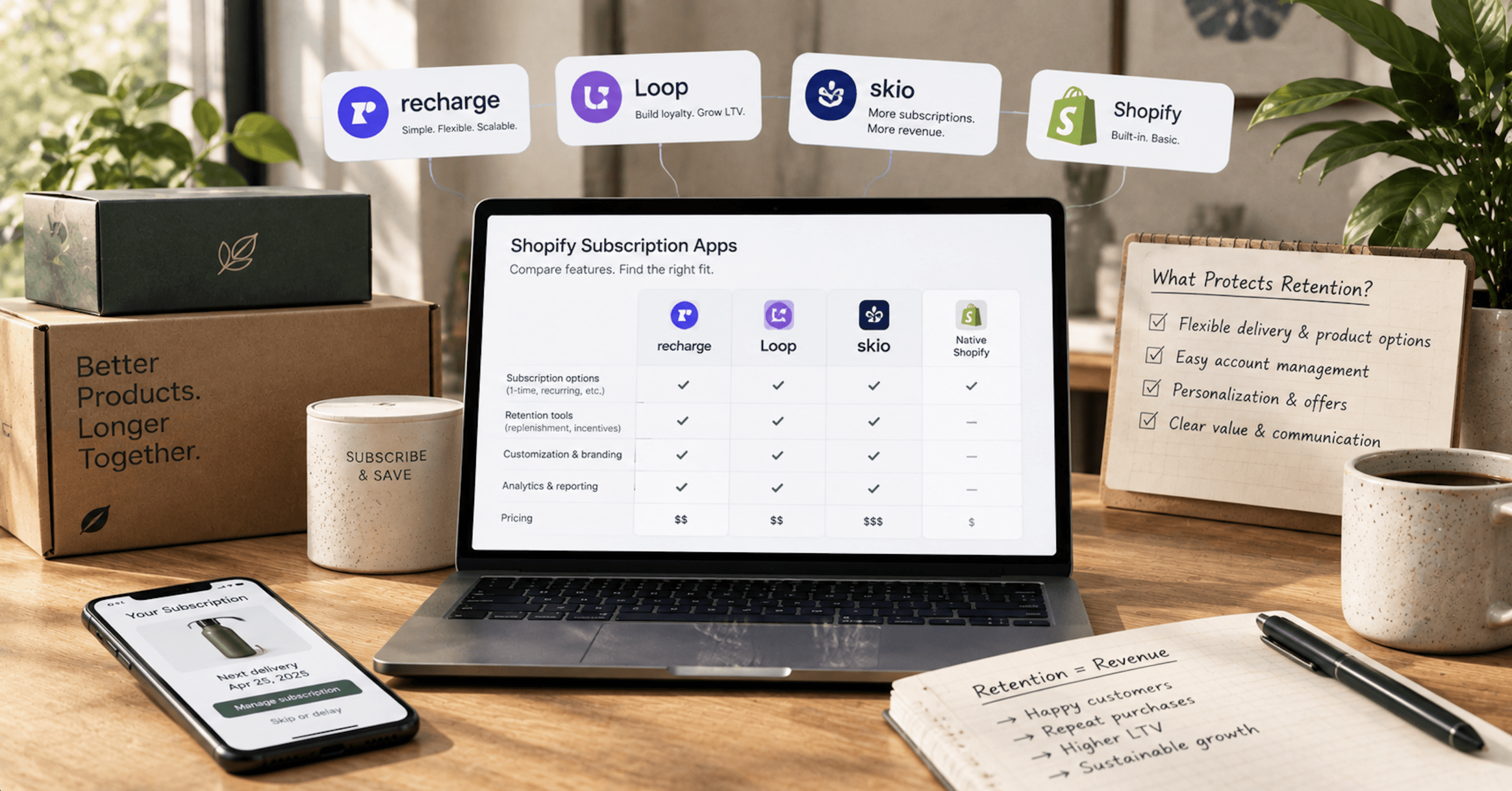
Choosing a Shopify Subscription App: Recharge, Loop, Skio, and What Protects Retention
Recharge acquired Skio in April 2026, so two of the names on your shortlist now share an owner. The best Shopify subscription app for your store comes down to two questions: what happens when a card fails, and what happens when you want to leave.
Not sure where the gap is? That's exactly what the Digital Marketing Growth Audit is for.
A free, no-obligation look at where your site can win more traffic and conversions, with a clear digital marketing roadmap to get there. Just a straight read on where your digital presence stands and where it's headed.