
Shopping ads don’t run on keywords. Google’s page on Shopping ads (opens in new tab) says they “use your existing Merchant Center product data (not keywords) to decide how and where to show your ads.” On Shopify, that makes the product feed the targeting layer, so a product that’s disapproved, missing a required attribute, or priced differently than its landing page can’t be bid back into the auction.
The other half is measurement. Smart Bidding prices auctions from conversion data, so when the conversion signal is incomplete the effect shows up as weaker campaign performance rather than as a tracking error. Feed and measurement decide most of what people attribute to campaign structure.
Everything below comes from Google’s and Shopify’s own documentation, linked in the sentence where it appears, and read on September 15, 2026. Both companies are describing their own products, so their recommendations are vendor recommendations and I’ll flag them as such where it matters. Where the two disagree, Shopify defers: every page in its Google & YouTube section carries the line that the channel (opens in new tab) “is managed by Google.”
What Google Ads For Ecommerce Actually Runs On
Google gives retailers two current options. The Shopping ads overview (opens in new tab) opens by telling retailers they can use “Performance Max campaigns with a Google Merchant Center feed or Shopping campaigns” to promote inventory. Both are built on the same Merchant Center product data, which is why feed work pays into either choice.
The requirements for Shopping ads (opens in new tab) are short, and they mean what they say. You need a Merchant Center account and a Google Ads account, linked. Your content has to comply with the Shopping ads policies, which Google says “are different from the Google Ads policies.” And you need to be able to send Google up-to-date product data “at least every 30 days.”
That 30-day rule reconciles with what Shopify documents on its side. Shopify’s syncing page says Google sets a “strict 30-day expiry policy” (opens in new tab) on synced product data and that the channel refreshes products within that window to avoid suspension or data loss. If you’ve ever seen products silently drop out of Shopping, expiry is one documented cause to rule out.
Feed quality also does a separate job on AI surfaces, which we covered in our piece on structured data for AI search. The consequence here is narrower and harder: an attribute problem doesn’t just make a product less legible, it makes the product ineligible, and the campaign can’t bid on what it can’t serve.
Do you even need Merchant Center to run Google Ads on Shopify? No, and Shopify documents the three connections as independent. Its connection page (opens in new tab) says you don’t need a Merchant Center account if you only want to use Google Ads and Google Analytics, and lists connecting Ads alone to “set up conversion tracking for your ads without syncing products.” Two preconditions apply: you need an existing Google Ads account, and the connected Google account has to be an administrator on it.
Account linking has constraints that shape how agencies and multi-store operators set things up. Google’s linking documentation (opens in new tab) says you can’t link a Google Ads manager account to Merchant Center, that a Merchant Center account can be linked to up to 500 Google Ads accounts, and that a campaign can only be linked to one Merchant Center account at a time. If you unlink, campaigns that rely on that product data stop using it to serve ads.
Two settings are permanent. The same page says that when you create a new Google Ads account during linking you provide your time zone and currency, and after the account is created “you won’t be able to change these settings later.” Performance Max adds its own version of this: Google’s campaign setup page (opens in new tab) says you can’t change the Merchant Center account after the campaign is created, and you’d have to build a new campaign to use a different one.
The Shopify Google Ads Traps That Cost The Most
The Google & YouTube channel is free to install, and the app listing (opens in new tab) says ad spend is billed directly to your Google Ads account with you setting the daily campaign budget. The install is easy. The documented side effects are where the money goes.
The most expensive one is on Shopify’s requirements page (opens in new tab), and it’s stated without ambiguity: if you already have a product feed set up, “then it’s overwritten to avoid conflicts between your Shopify store and your Merchant Center account.” A store running a hand-built or third-party feed with custom rules, curated titles, and excluded SKUs loses that configuration when the channel syncs. Export the existing feed and document every rule before you connect anything.
Several other constraints come from the same pages, and each one changes a setup decision:
- Multi-client Merchant Center accounts can't be used to sync products through the channel, which matters for agency-managed and multi-brand structures.
- Each Merchant Center account connects to one Shopify store at a time, and trying to connect one that's already attached returns an error.
- Product options, including variants, have to be in English to sync with Google.
- Transferring a domain claim removes it from the original Merchant Center account, and data feeds in that account which link to your domain get automatically disapproved.
- Only rates in your General shipping profile sync, and Shopify says custom shipping profiles "will sync incorrectly with Google Merchant Center and cause errors."
- Carrier-calculated rates are supported for certain carriers and services in Australia, Germany, and the United States only, so everyone else needs flat rates.
- Headless storefronts are called out by name as a domain-verification problem when the front end uses a different domain than the one configured in Shopify, because product links then don't match.
What happens if you tick a requirement you haven’t actually met? Shopify’s connection page says plainly that if you confirm requirements that aren’t met, “Google can suspend your Merchant Center account.” The contact-information checkbox is manual precisely because the channel can’t detect that information automatically, which makes it the easiest one to click through carelessly.
Support splits at the account boundary, and knowing that saves a day when something breaks. Shopify says its support can help with installing the channel and setting up products in Shopify, but that Merchant Center issues, Google Ads issues, account suspensions, and ad approvals go to Google directly. Sync timing is also documented: initial syncing can take up to 24 hours, and after that, product changes typically sync within a few hours.
The Multi-Market Split That Resets Your Performance History
Google’s Shopify-specific Merchant Center documentation (opens in new tab) describes a change most merchants meet after it’s already happened. To align with Shopify’s multi-market configurations, products in overlapping markets are separated into dedicated country data sources. Because they land in a new data source with a new label using the two-letter country code, Google says “the system treats them as new items, which resets their performance history.”
The campaign consequence is stated on the same page. Campaigns that filtered products by an old data source label, Google’s example is “USD_market_1”, will no longer capture the products that moved into the new country data sources, and you have to update those campaigns to the new country code label. Campaigns targeting all products aren’t affected. Attribute rules don’t come along either: Google confirms rules applied to previous data sources won’t automatically transfer.
One piece of good news is documented alongside it. The underlying raw product IDs, the shopify_ZZ_ values, stay unchanged, so Google says conversion tracking continues to function normally. The break is in targeting and history, not in attribution.
The decision this forces is a pre-flight one. Before you open a second market, list every campaign that filters by data source label and every attribute rule you’ve built, because both are things you’ll be rebuilding on the other side. Google also warns that the split increases your total offer count, so a catalog near its limit may need a quota increase before the new data sources fill.
What Merchant Center Requires Before Google Ads For Ecommerce Can Serve
Google publishes the exact preconditions a data source has to meet before it’s even sent for review. The Merchant Center issues page (opens in new tab) lists shipping settings configured at account or item level where shipping is required, a data source created for the target country, a claimed and verified URL, a verified business address, and, for the United States, tax settings at account or item level. Google’s Performance Max setup page (opens in new tab) repeats the same list as a precondition for building the campaign at all.
Shopify’s requirements add the store-side half. You need an online store that isn’t in private mode, a valid payment provider, and a Refund Policy and Terms of Service that the page specifies “must be available in your footer menu.” You also need visible contact information with at least one of a mailing address, phone number, email address, or contact form, and you need to ship to a supported country in a matching currency.
The account-level rules in Google’s Merchant Center guidelines (opens in new tab) are where ordinary DTC stores trip. Products you promote have to be purchasable through your online store. You can’t promote affiliate or pay-per-click links except as a participant in a CSS program country. Users have to be able to add products to the cart and complete checkout, with at least one conventional payment method available.
Two smaller rules sit on the same page. Google says to state your return policy explicitly even if you don’t offer returns or refunds, and notes that you process returns yourself because Google doesn’t approve or handle them. It also asks you to sign in to Merchant Center at least once every 14 months to keep the account active, which is a real failure mode for a store that set this up once and moved on.
Four Review Timelines That Stall Google Ads For Ecommerce
Four different published timelines govern how long you wait, and they apply to four different things. Google’s issues page gives 3 to 5 business days for new product review and 24 to 48 hours for a re-crawl after a fix, while the misrepresentation policy page (opens in new tab) gives 7 business days as the typical account review. Conflating them is how a merchant ends up believing a suspension appeal resolves in three days.
| What’s under review | Published timeline |
|---|---|
| New products after initial sync | Up to 3 to 5 business days for Shopping ads, and Google says it may be longer for other programs, with products held in “Pending” |
| Account review at the end of a warning period | Up to 7 days |
| Account review after a misrepresentation suspension | Typically 7 business days, longer for complex reviews |
| Re-crawl after a technical fix or an appeal | Usually 24 to 48 hours |
Warnings and disapprovals are also distinct states. Google says products with warnings “will continue to show across Google, however their performance may be limited,” and that unresolved warnings can lead to disapprovals, while disapproved products stop showing entirely. Preemptive item disapproval is a third state: when price or availability don’t match between your product data and your landing pages, Google disapproves products likely to violate requirements, and a review is required to clear it.
Most disapprovals trace to the website rather than the feed, and Google lists the causes. Placeholder content, broken links, missing or inconsistent information, inaccurate product descriptions, mismatched categories between site and product data, a robots.txt blocking Googlebot or Googlebot-image, landing pages that are unavailable through server errors or slow loading, and landing pages that redirect to a generic page instead of the specific product.
For account-level violations, Google says it sends a warning email and gives you 7 or 28 calendar days to fix the issue, but that it may not issue a warning for egregious violations. The issues page adds that in some cases an egregious account-level issue results in immediate suspension with no warning at all. It also notes that merchants on a third-party platform may be able to request a review directly through that application, which is the route a Shopify merchant takes from inside the channel.
Which suspension policy should a Shopify store read first? Misrepresentation, because Google scopes that policy on the page itself to Shopping ads and local inventory ads rather than to all of Google Ads, and because its consequences are the harshest published. Google calls violations “egregious,” says accounts will be suspended “upon detection and without prior warning,” and says accounts are only reinstated “in compelling circumstances.” The omissions it lists as violations are mundane: missing merchant terms and conditions or shipping information, and a return and refund policy that’s unclear, missing, or not easily discoverable.
Two procedural warnings on that page change how you should respond to a suspension. Google says that before submitting a bulk appeal you must remove policy-violating items, because a bulk appeal across a large set of offers “risks immediate failure if violations are found,” which may limit your ability to appeal those products again. And it says not to delete a suspended account and create a new one, since the new account is likely to be flagged as well.
The Feed Attributes That Decide Whether Your Products Serve
Google’s product data specification (opens in new tab) defines its own tiers, and the Required definition is the operative one: “Submit this attribute. If you don’t, your product won’t be able to serve in ads and free listings.” Everything below is from that spec unless noted. It’s the difference between a feed that’s merely imperfect and one that’s ineligible.
The universally required set is small. An id capped at 50 characters, which Google says should use the product’s SKU where possible and should stay the same across updates. A title capped at 150 characters and a description capped at 5,000. A link on your verified domain, an image_link, an availability value from in_stock, out_of_stock, preorder, or backorder, and a price.
Price rules cause avoidable disapprovals on Shopify stores that run memberships or subscriptions. Google says not to submit a price of 0 outside the narrow cases of mobile devices sold with a contract and physical goods sold with a subscription, and that any customer must be able to buy at the submitted price “without having to sign up for a membership program (free or paid).” For the US and Canada, don’t include sales tax, GST, VAT, or import tax in price; for all other countries, include VAT or GST.
Identifiers have an asymmetric penalty that’s worth internalizing. The spec says products that have a GTIN but are submitted without one “may have limited visibility,” while a product submitted with an incorrect GTIN “will be disapproved.” Google’s GTIN attribute page (opens in new tab) reinforces the point: only provide a GTIN if you’re sure it’s correct, don’t guess, and don’t submit one for a product that doesn’t have one, which is the normal case for store brands and single-seller products.
The identifier_exists attribute defaults to yes if you don’t submit it, per the spec, and setting it to no when the product does have identifiers may get the product disapproved. Variants need their own unique identifiers: Google says if a product comes in multiple colors or sizes, each variant needs a different unique identifier, and it prohibits submitting multiple products for the same country and language that share a GTIN and have identical variant attribute values. GTIN format is 0, 8, 12, 13, or 14 digits, repeatable up to 10 times.
One detail is genuinely contradictory across Google’s own pages, so treat it as unsettled rather than resolved. The GTIN attribute page describes coupons as carrying GS1 prefix ranges “05, 98 or 99”, while the product data specification describes a coupon as GS1 prefix ranges “98 – 99”. Both pages were live on the same day. If your catalog is anywhere near that edge, validate against the attribute page and expect the spec to disagree.
Availability is the attribute most likely to break quietly as inventory moves. Google’s availability page (opens in new tab) requires consistency “across the landing page, structured data (if available), checkout page, and your data source,” and says a mismatch in one of these will trigger a product disapproval. For in-stock offers the buy button has to be active, and for preorder or backorder items the page has to display the expected shipping date.
Google also distinguishes preorder from backorder in a way many feeds get backwards: preorder is only for new products that haven’t been released yet, while existing products that are out of stock and will return should use backorder. For temporary removals, Google says to use the pause attribute to stop a product showing for up to 14 days, and to use excluded_destination rather than setting products to out of stock when you take the site down for maintenance or a holiday. It warns explicitly against deleting items, because adding an offer back after deletion “will take a significant amount of time before it can show again.”
Images carry a dated requirement that belongs on your 2026 roadmap. Google’s image link page (opens in new tab) announces new image size requirements of at least 500 by 500 pixels for all products “beginning January 31, 2027,” while recommending 1500 by 1500 or above for best performance across listing formats. Hard limits are 64 megapixels and 16MB per file.
The re-crawl behavior on that page changes how you should ship new photography. Google says a new unique image URL “prompts a faster recrawl, typically within 3 days (24-72 hours),” while reusing the same URL “can take significantly longer (up to 6 weeks).” That’s roughly a fourteenfold difference by my arithmetic on Google’s own published windows, and the fix is free: change the filename rather than overwriting the asset in place.
Promotional overlays remain a common disapproval cause, and Google’s banned list is specific: calls to action like “buy”, service information such as extended warranty or free shipping, price information, promotional adjectives like best or cheap, condition or compatibility claims, watermarks, brand names, logos that aren’t an inherent part of the product, and barcodes. Borders are out too. Google’s framing advice, which it labels as advice rather than requirement, is to frame the product at no less than 75% and no more than 90% of the image space on a solid white or transparent background.
Free Listings And Google Shopping Ads Don't Require The Same Attributes
Free listings are a separate program with their own requirements, and Google says on the free listings page (opens in new tab) that the feature “is turned on by default for you” in most cases. Products can appear on Google Search, Google Maps, Gemini, YouTube, the Shopping tab, Google Images, and Google Lens. Shipping settings or the shipping attribute are required in a named country list that includes the US, UK, Canada, Australia, and most of the EU.
Two requirement sets diverge in a way that’s easy to get backwards. The product data specification says item_group_id is required in Brazil, France, Germany, Japan, the UK, and the US if the product is a variant, and separately “required for free listings for all product variants” with no country scoping. The four apparel attributes, color, size for clothing and shoes, age_group, and gender, follow the same pattern: Google’s Shopify page says they’re needed to show Apparel & Accessories products in free listings, and to show them in Shopping ads targeting those same six named countries.
The practical read is that free listings are the stricter of the two on variant and apparel data. A store selling apparel outside those six countries can be fully eligible for Shopping ads while its variants stay ineligible for free listings, which looks like an unexplained visibility gap if you’re only watching the ads account.
The Shopify Setting That Controls Your Google Shopping Ads Titles
Google documents a Shopify-specific control that decides what actually lands in your feed’s title field. In its Shopify integration documentation, Google says you can either sync your product titles and descriptions or “use the title tag and meta description from the search engine listing,” and gives the reason: you might want the search listing versions so you can include more keywords for search engine optimization on Google Shopping without changing product information in your store. The control sits in the Google & YouTube app under Settings, then the Product feed section, then “Additional settings to sync with Google Merchant Center” under Product sync, then “Product titles and descriptions.”
Title rules split cleanly into requirements and advice, and Google’s title page (opens in new tab) marks the line itself. Under “Minimum requirements” it says “If you don’t follow these requirements, we’ll disapprove your product,” then requires accurate titles matching the landing page, variant differentiation, no promotional text including price, sale dates, shipping, delivery dates, or your company name, and no capital letters for emphasis. Shopify illustrates the capitalization rule with the fix from “GREEN SHIRT” to “Green shirt.”
The best practices are labeled as best practices, which is how they should be weighted. Google suggests using all 150 characters, putting the most important details first because “users will usually notice only the first 70 or fewer characters of your title, depending on screen size,” and using keywords. If a title exceeds the limit Google truncates it and sends a warning that it did.
If you’re using structured attributes, precedence matters: Google says when both structured_title and title are provided, “we’ll only use the title [title] attribute.” AI-generated titles have their own path, requiring structured_title with a digital_source_type of trained_algorithmic_media.
Google may also rewrite your title in the ad. It says it “may promote key product attributes using content from your landing page, images, and other signals,” and gives a worked example where a query for “King size mattress” turns a merchant title beginning “Memory foam medium firm mattress king” into a dynamic title beginning “King – Memory foam medium firm.” An opt-out exists through your account manager or support, with requests typically processed in 3 to 5 business days.
Product status in the Shopify app tells you where each product stands, using four values: Not approved, Limited, Under review, and Approved. Google defines Limited as only some products syncing because of errors or missing product data. A store sitting at Limited for weeks should start with the troubleshooting set Shopify names: missing description, missing image, unavailable landing page, missing GTIN or MPN, promotional overlay on image, and excessive capitalization.
Performance Max Or Shopping Campaigns For Ecommerce PPC
Start with what’s no longer a choice. Shopify’s Performance Max page (opens in new tab) says Performance Max campaigns replace Smart Shopping, that existing Smart Shopping campaigns were automatically upgraded, and that “you can no longer create Smart Shopping campaigns.” Any decision framed as Smart Shopping versus PMax is a decision about a campaign type you can’t create.
Standard Shopping, by contrast, is alive. Google’s Shopping ads page presents it beside Performance Max in a comparison table of current options, and the differences in that table are the real decision inputs.
| Performance Max | Shopping campaigns | |
|---|---|---|
| Where ads appear | Most Google Ads channels: Shopping tab, Search next to results, Search text ads, Images, Display, YouTube, Gmail, Demand Gen, Maps via local inventory ads | Selected channels: Shopping tab, Search next to results, Images, and Search Partner sites if enabled |
| Ad formats | Shopping, local inventory, display, text, YouTube, and vehicle ads | Shopping, local inventory, and vehicle ads |
| Billing | You pay for performance, for example clicks or CPM | Charged on cost-per-click |
| Bidding | Maximize conversion value with optional ROAS target, Maximize conversions with optional CPA target | Target ROAS, Maximize clicks, Maximize conversion value, and Manual CPC |
| Creative | Auto-generated or optimized from asset group assets and the Merchant Center feed | Built from the Merchant Center feed; Google says additional creative assets are “not available yet” |
| Local inventory ads | Opted in automatically when a local products inventory feed is attached | Requires enabling ads for products sold in local stores |
One row in that table answers the question of why anyone still runs Standard Shopping: Manual CPC appears under Shopping campaigns and not under Performance Max. If you need to set the price of a click yourself, Google’s own comparison points you to Shopping campaigns.
Performance Max is defined on its overview page (opens in new tab) as a goal-based campaign type that accesses all Google Ads inventory, including YouTube, Display, Search, Discover, Gmail, and Maps, from one campaign. You can create one when your objective is Sales, Leads, Website traffic, or Local store visits and promotions, or with no goal guidance. Its campaign-level controls are keywordless targeting, Final URL expansion or asset optimization, search themes, negative keywords, and brand exclusions.
The interaction between PMax and your Search campaigns is the most operationally useful thing Google publishes about it. The overview says Search campaigns containing an exact match keyword “are prioritized to serve over Performance Max when a query hits an exact match keyword,” and that search themes carry the same priority as phrase and broad match keywords. Then it adds the condition that reverses the outcome: “If your Search campaign is budget-limited, Performance Max may occasionally serve on exact match terms.”
That turns an underfunded Search campaign into a PMax targeting decision you didn’t make. If you run both and your brand or highest-intent Search campaign is capped, the documented behavior is that PMax can pick up those exact match queries. Funding the Search campaign is the control, not a PMax setting.
Search themes and brand exclusions are the two levers worth learning properly. Google says you can add up to 50 search themes (opens in new tab) per asset group, and describes them as a broader signal to its AI rather than as keywords. Brand exclusions (opens in new tab) apply to both Search and Shopping ads within PMax, block misspellings and related subsidiary brands automatically, and, usefully, can be configured to let Shopping ads keep serving on those excluded brand terms.
Final URL expansion moves a decision from you to Google, and Google is explicit about who stays responsible. It says that with expansion on, Google may replace your Final URL with a more relevant landing page and generate a matching dynamic headline and description, then notes “you remain responsible for reviewing and ensuring compliance and accuracy of landing page content, and all dynamically generated assets.” One more constraint from the setup page: text customization can’t be applied to Shopping Ads.
On cost, Google’s Performance Max costs page (opens in new tab) says there are no startup costs and you pay for performance, with billing that varies by surface. YouTube instream is billed on CPM, while Search, Shopping, and Display are billed on clicks.
A single campaign therefore mixes several billing bases, not one. Beyond CPM and clicks, Google bills a Gmail teaser click to expand the ad as an “engagement” and charges Promoted Pins on Maps by views when you’re bidding to store visits or store sales. Compare its cost per click to a Shopping campaign’s and you’re comparing across all of those bases at once.
What Performance Max Reports, And What It Doesn't
Performance Max has a search terms report, and it has had one for years. Google’s page on the PMax search terms report (opens in new tab) describes it as showing the search terms that triggered your ads, living under the Campaigns menu as “Search terms and landing pages for Performance Max.” Data in that report starts from March 2023, and Google says data prior to that date isn’t shown.
Segmentation is what makes the report usable for a retailer. Google says you can use “Ad format” segmentation to see the ad type served for each search term, differentiating between Shopping ads and text ads, and that this helps analyze format-level brand exclusions. The report includes terms that don’t lead to conversions, so it isn’t a converted-queries-only view. Store visits and store sales conversions aren’t available in it.
There’s a documented caveat about coverage, and its subject matters. Google’s general search terms report page (opens in new tab) says some search terms without enough query activity are omitted to meet its data privacy standards. That’s a documented property of the search terms report generally, and the PMax page doesn’t restate it, so treat low-volume suppression as a property of the report you’re viewing rather than as a PMax-specific rule Google has published.
Acting on what you find takes two different routes. Google says to stop serving for a keyword on Search and Shopping inventory you apply negative keywords at account or campaign level, while Display and Video inventory requires excluded content keywords in the Content Suitability center. One exclusion list doesn’t cover the campaign.
The accurate criticism of PMax reporting is about placements, and Google makes it itself. The placement report page (opens in new tab) says placement reports “shouldn’t be used to evaluate performance, as information on the placement report doesn’t include performance from all channels,” and that they “should be used as a brand safety tool.” It also states the structural reason: “Search isn’t considered a placement, and is excluded from any placement reporting.”
The report carries two more limits. Google Owned & Operated is a single bucket combining impressions from some YouTube formats, Discover, Feed, Gmail, and other Google properties, and “Anonymous.google” covers placements where publishers have chosen not to disclose their site name. Google frames the report around where ads served and how many impressions they received, and its own walkthrough builds a custom version on the impressions column. Google’s costs page compresses all of this into an instruction: use placement reports for brand safety, not performance evaluation.
Asset group reporting has a similar shape, with a warning against the obvious instinct. Google’s asset group reporting page (opens in new tab) describes a Combinations report listing the 6 best combinations per asset category across 18 tiles for text, image, and video. Then it says asset groups with higher CPA or lower ROAS “still contribute to achieving your campaign goals, and we don’t recommend removing asset groups based on this information.”
There’s also a math caveat on that page that explains a discrepancy people frequently report as a bug. Google says conversions aren’t split across multiple components of an ad, so the number of conversions across all assets won’t equal total conversions for the campaign. Asset-level conversion numbers aren’t additive, and treating them as a budget allocation view produces a wrong answer.
So the honest summary is narrower than “black box” and more useful. PMax exposes search terms back to March 2023, ad format segmentation, asset and asset group performance, channel performance, and a placement report Google says is for brand safety. What isn’t documented on any of these pages is per-channel spend allocation control or placement reporting that covers Search, and Google’s stated instruction is to evaluate at the campaign level because the system optimizes across channels against your conversion objectives.
Measurement Is The Half Of Google Ads For Ecommerce That Decides The Other Half
Shopify’s current mechanism is the pixels manager, and its pixels overview (opens in new tab) documents two paths: app pixels installed through marketing and data collection apps, and custom pixels added by a developer in the pixels manager. The coverage question has a documented answer today: “Pixels automatically load on the Storefront, Checkout, Thank you page, and Order status page.” Customer account pages are the exception, loading pixels only after you connect a custom subdomain, and tracking only the page_viewed event there.
That’s the steady state after the Additional Scripts field went away for non-Plus stores, which we wrote about when Shopify’s Additional Scripts sunset broke conversion tracking. What ended was the script field, not conversion measurement on checkout pages.
The sandbox is where paid media implementations still hit walls. Shopify says pixels sandboxes can’t render user interface elements like buttons, forms, banners, or modals, and lists what can’t be detected: events, metadata, and user information such as email and phone from DOM scraping, outbound link clicks from DOM scraping, page scrolling, and click and mouse-movement heatmaps. It also notes that automatic detection of page URLs in the Lax sandbox includes a sandbox version that may not exactly reflect the main window’s URL.
For conversion pixels specifically, Shopify says standard checkout events and customer actions work for most conversion tracking, that features which automatically scrape forms for email addresses or phone numbers might not work in the sandbox, and that most pixel providers support passing that data manually instead. Running Google Tag Manager doesn’t route around this: Shopify says GTM can run as a custom pixel, but pixels it loads still run within the sandbox with the same limitations.
Google’s enhanced conversions (opens in new tab) works by sending hashed first-party data, using hex SHA256 on customer data such as email addresses before it reaches Google. Normalization is specified: strip leading and trailing whitespace, lowercase the text, format phone numbers to E.164, and remove periods preceding the domain in gmail.com and googlemail.com addresses. Google’s enhanced conversions for web page (opens in new tab) adds a 2026 change: web and leads are now a single on/off setting, and from April 2026 Google accepts user-provided data from website tags, Data Manager, and API connections, with existing users migrated automatically.
Those two sets of facts sit next to each other and the join is yours to make deliberately. Shopify documents that DOM scraping for email and phone doesn’t work in the sandbox and that providers support passing the data manually; Google documents that enhanced conversions needs user-provided data such as a hashed email. No page on either side states the merged conclusion, so treat “how does user-provided data reach the tag on this store” as an implementation question to answer during setup rather than as a requirement either vendor has written down.
Conversion configuration has three details that quietly decide bidding quality. Google’s conversion measurement page (opens in new tab) calls configuring conversion actions as primary or secondary “critical,” since primary actions are the biddable ones. It says an Unverified or Inactive status is normal for new tags until the first conversion or test event is recorded. And it notes view-through conversions are excluded from the main Conversions column so Smart Bidding optimizes for active interactions.
Your data source choice is also documented rather than a matter of taste. Google says Google Analytics is the most efficient choice if you already use it and want to reuse existing event tracking, while the Google tag is recommended if you don’t use Analytics or if you need Ads-specific features like enhanced conversions. If you import from Analytics, expect a wait: Google says it can take 24 to 48 hours after linking or marking key events before import options appear in Google Ads.
Consent shapes all of this in the EEA and UK, and both vendors document their own half. Google’s consent mode page (opens in new tab) says consent mode doesn’t provide a banner, it interacts with yours, and distinguishes basic mode, where tags don’t load until interaction and no data including consent status is transferred on refusal, from advanced mode, where tags load and send cookieless pings while consent is denied. Advanced mode uses an advertiser-specific model rather than a general one, and Google says after at least 7 full days of implementation there may be enough data to report uplift.
Shopify’s half is its customer privacy settings and the consent gate in the pixels manager. Its pixels page says that in markets configured to require consent, usually the EEA and UK, web pixels run only when visitors have given the required permissions, with new pixels defaulting to requiring Marketing and Analytics permissions. Its customer privacy settings documentation (opens in new tab) states the measurement consequence directly: where a cookie banner is active, data is collected only after consent, so there might be a reduction in the amount of data available for analytics, marketing, and personalization. Shopify says that’s observable through decreased session counts and other metrics that rely on session data, “including conversion rates.”
What Shopify documents is the gate on whether a pixel runs at all, and it covers the Google Consent Mode v2 wiring directly. The stake is specific: event data sent to Google from customers in the EEA won’t be used for personalized advertising unless Consent Mode v2 is activated and valid consent is obtained.
A Shopify cookie banner can capture that consent, a third-party banner has to be integrated with Shopify’s customer privacy settings, and a custom web pixel needs a code snippet inserted manually to activate Consent Mode v2. That last case is the one to check, because it’s the only one where nothing happens by itself. Shopify’s pixels page adds one more gate on the same mechanism: pixels configured as data sale won’t run for customers who have opted out of data sales or sharing, unless the pixel supports limited data use.
The Google Ads For Ecommerce Minimums That Don't Exist
Google publishes conversion thresholds for Target ROAS eligibility, and the list is specific. On the Target ROAS page (opens in new tab), Search and Shopping campaigns need at least 15 conversions in the past 30 days at the conversion tracking level, Display needs at least 15 conversions with valid values across all campaigns combined, and App campaigns need at least 10 conversions daily or 300 in 30 days.
The rest of the list runs: Demand Gen needs at least 50 conversions in the past 35 days with 10 of them in the past 7 at campaign level, or 100 in 35 days across all Demand Gen campaigns in the account; Video Action needs at least 30 in the past 30 days; Hotel campaigns need 50 per week at campaign level; and Travel needs 50 in the past 7 days at campaign level. Google adds that conversions must have a value greater than zero to count. Note the unit differences, because Search and Shopping are measured at the conversion tracking level while several others are scoped to the campaign.
Performance Max is not among the seven campaign types on that page. The page references PMax elsewhere, noting that portfolio bid strategies aren’t available for it and that average target ROAS reporting is supported, but it doesn’t assign PMax a conversion threshold. So there’s no published Target ROAS conversion minimum for Performance Max to quote, and any figure you’ve been given for one came from somewhere other than that documentation.
Is there a minimum daily budget for any of this? Not one that Google documents. Across the Shopping, PMax, Demand Gen, budget, and bidding pages, no minimum daily spend is stated for any campaign type. The closest published guidance is the budget panel Google puts on the Performance Max and Demand Gen campaign review pages, which it says displays up to 3 daily budget suggestions labeled Low, Medium, and High, “based on your campaign settings and account history,” with the lowest being the minimum recommended budget for that campaign.
That phrasing leaves something unstated worth noticing. A brand-new account has no account history for the suggestion to draw on, and Google doesn’t say what the recommendation falls back to in that case. Treat the Low figure as a system output rather than a documented floor.
One budget-to-target ratio exists, scoped to a single campaign type. Google’s Demand Gen page (opens in new tab) says that for campaigns using target CPA bidding, it recommends a budget at least 10 times your target CPA. That’s Demand Gen guidance on a Demand Gen page. Transplanting it onto Performance Max or Shopping produces a number Google has never published for those campaign types.
It’s also worth running the arithmetic on what that ratio implies, because it’s larger than it sounds. At a $30 target CPA, 10x means a $300 daily budget, and using Google’s own monthly multiplier below, that’s roughly $9,120 in a month. That’s my math off Google’s published figures, not a Google-published total.
The spend mechanics Google does publish are on its average daily budgets page (opens in new tab): you’ll never pay more than two times your average daily budget on a given day, or 30.4 times your average daily budget in a month, which Google scopes to “most campaigns” rather than to all of them. Google’s own worked example divides 304 by 30.4 to give $10 per day.
Applying those multipliers, a $50 daily budget can spend up to $100 on a single day and up to $1,520 across a month, which is the number to bring to a finance conversation rather than $1,500. The Target ROAS page makes the same point as advice, recommending you be comfortable spending up to twice your average daily budget.
Two learning numbers exist in Google’s documentation and they measure different things. The conversion measurement page says Smart Bidding strategies “require a standard 7-14 day learning phase” and warns against frequent manual changes to budgets, targets, or conversion goals during it, because those adjustments reset the learning window. The learning period page (opens in new tab) gives a data threshold instead: “up to around 50 conversion events or 3 conversion cycles for the bid strategy to calibrate,” faster when more conversion data is present. One is a duration and one is a volume, so a campaign can satisfy the first and still be short of the second.
Joining those two pages produces an uncomfortable number for small catalogs. A store sitting exactly at the Search and Shopping eligibility floor of 15 conversions in 30 days would take roughly 100 days to accumulate 50 conversion events, which is my arithmetic across two Google pages rather than a rule Google states. Eligibility for a bid strategy and having enough data for it to calibrate are not the same milestone.
Google’s bid strategy statuses page (opens in new tab) names three things that put a strategy into Learning: a new strategy, a setting change, and a composition change where campaigns, ad groups, or keywords move in or out. Its advice is to keep using the account normally while being mindful that metrics vary. The learning period page adds a fourth trigger, saying ad group target changes may trigger Learning on Shopping campaigns, and adds a caveat that keeps everyone honest: “Our algorithms continue to learn even when the bidding status no longer shows ‘Learning’.” It also notes the learning period isn’t applicable to Manual CPC.
Separately, Google publishes guidance on the window you should judge results over, and it isn’t an eligibility rule. Its Smart Bidding page (opens in new tab) recommends measuring performance over periods with at least 30 conversions, or 50 for Target ROAS. The Target ROAS page adds that you should report values across relevant campaigns for 4 weeks or 1 to 2 conversion cycles, whichever is longer, before setting a target, and that performance generally improves with fewer, larger campaigns.
Finally, a dated change that landed five weeks before this published and is worth ruling in or out before you rebuild anything. Google’s Target ROAS page states: “Starting August 17, 2026, Google is updating its bidding systems to deliver more consistent and predictable performance for campaigns that are limited by budget. If your campaigns use Target CPA or Target ROAS, these changes may cause temporary performance and traffic fluctuations.” The same page references a Bid Target Adjustment Tool available starting July 6, 2026, and notes that from June 2026 the strategy labels changed, with “Maximize conversions with a Target CPA” becoming “Target CPA” and the ROAS equivalent becoming “Target ROAS,” while the underlying behavior stays the same.
Budget-limited describes a lot of small Shopify advertisers. If performance moved in late August without a corresponding change on your side, that’s a documented cause to check before you start attributing it to creative fatigue or seasonality.
Google Publishes No Ecommerce PPC Benchmarks
Across Google’s Shopping ads, Performance Max, PMax costs, Demand Gen, Merchant Center guidelines, and free listings documentation, there’s no published click share, no average ROAS, no CTR, no conversion rate, and no PMax-versus-Shopping performance comparison. The quantities Google does publish about outcomes are spend mechanics, bid strategy eligibility thresholds, and learning thresholds, all of which appear above.
The one other category of number is reach marketing about its own surfaces, and it arrives without methodology. Google’s Demand Gen page claims the campaign type “lets you reach more than 3 billion active monthly users with more than 50 billion global daily views on Shorts alone,” which is a vendor figure with no stated measurement basis. It tells you about inventory scale and nothing about what your account should expect.
So any ecommerce benchmark you’re handed came from someone’s case study, panel, or aggregated client data rather than from Google. That doesn’t make those figures worthless, but it does mean they carry a sample you can’t inspect, and they can’t settle a question about your catalog, your margins, or your market. Your comparison set is your own account history. Record a clean baseline before you change campaign structure, not after.
Where To Start With Google Ads For Ecommerce
Most of these steps gate the ones after them, so the order is fixed.
- Clear the Merchant Center preconditions first: claimed and verified URL, verified business address, shipping settings, US tax settings, and policies reachable from your footer.
- Export and document any existing feed before connecting the Google & YouTube channel, since connecting overwrites it.
- Fix the required attributes and the availability consistency chain across landing page, structured data, checkout, and data source, since a mismatch in any one of them disapproves the product.
- Decide your title source deliberately in the app's product feed settings, and front-load the words a buyer would recognize.
- Get conversion measurement verified before bidding depends on it, including how user-provided data reaches your tag if you want enhanced conversions.
- Choose the campaign type on control requirements rather than on preference, remembering that Manual CPC lives only in Standard Shopping.
- Set a reporting cadence at the campaign level, using the search terms report with ad format segmentation for query decisions and the placement report only for brand safety.
We build and run these stacks in-house, feed through campaign through measurement, which is why the feed work and the ads work don’t sit with different teams here. If you want to know which of the steps above is actually costing you, our Google Shopping and Performance Max management work starts where yours is breaking rather than with a rebuild you didn’t ask for.
You built products worth finding. Get a free Growth Audit of your Google Ads and feed setup and see exactly why they aren’t being seen, and what it takes to fix it.
No sales call. No quote request. A clear look at what’s in your way.
What Shopify Sidekick Actually Does in Your Admin, and What It Can’t
Sidekick is Shopify’s AI assistant for your admin, not your storefront. Here’s what Shopify says it can do, the five things it can’t, and which tasks to hand it.
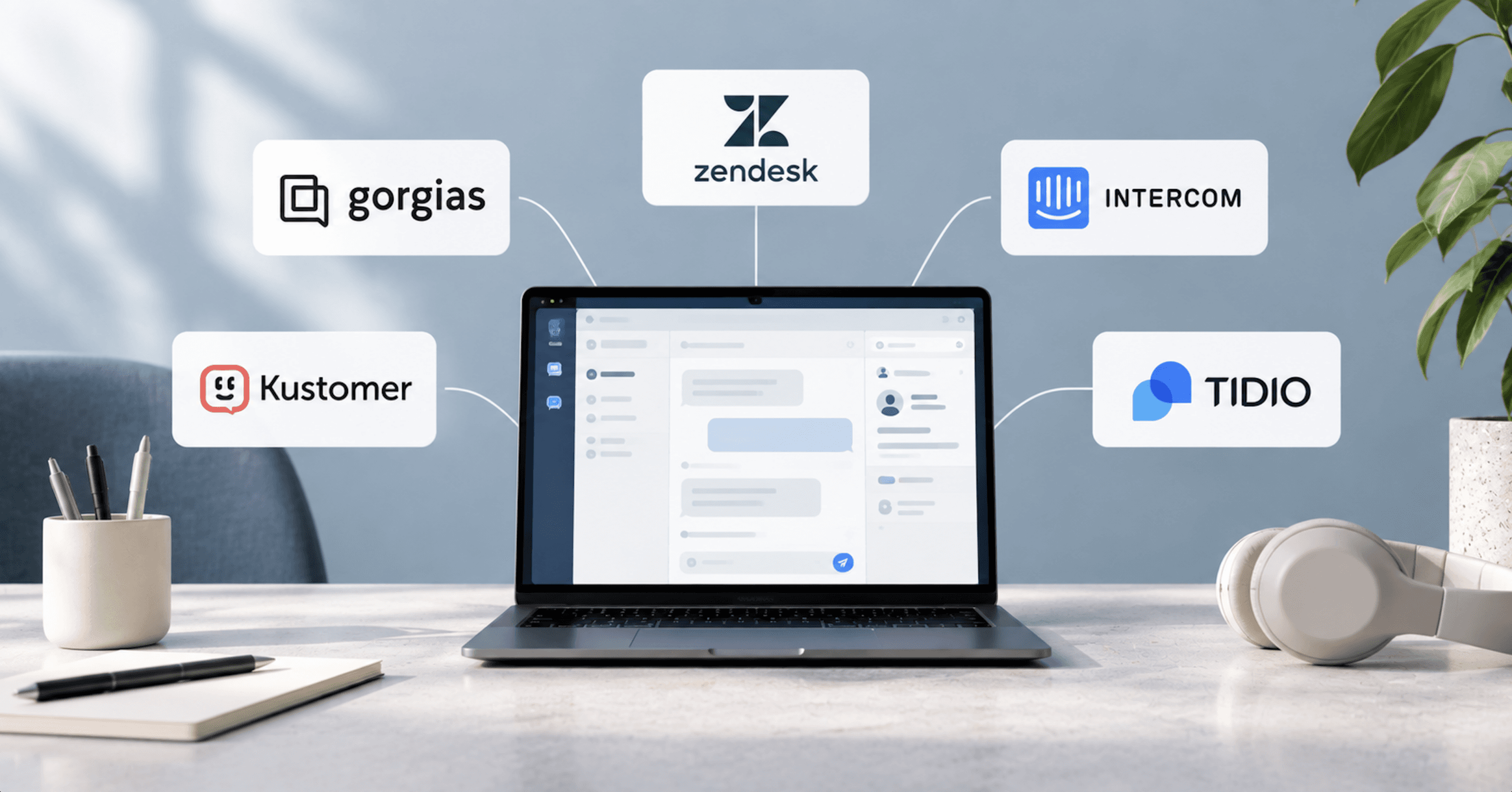
Gorgias Alternatives For DTC Support: How The Main Options Compare
Every Gorgias alternative bills on a different unit, charges for a different AI event, and documents a different set of Shopify order actions. Here’s how those three things line up, vendor by vendor.

What an AI Shopping Assistant Actually Does on Your Store
Shopify now ships a free, customer-facing AI shopping assistant on Basic through Plus, so most stores already have one. The question isn’t whether to buy. It’s what the thing reads, what it can’t do, and what you’d actually pay a vendor to fix.
Not sure where the gap is? That's exactly what the Digital Marketing Growth Audit is for.
A free, no-obligation look at where your site can win more traffic and conversions, with a clear digital marketing roadmap to get there. Just a straight read on where your digital presence stands and where it's headed.