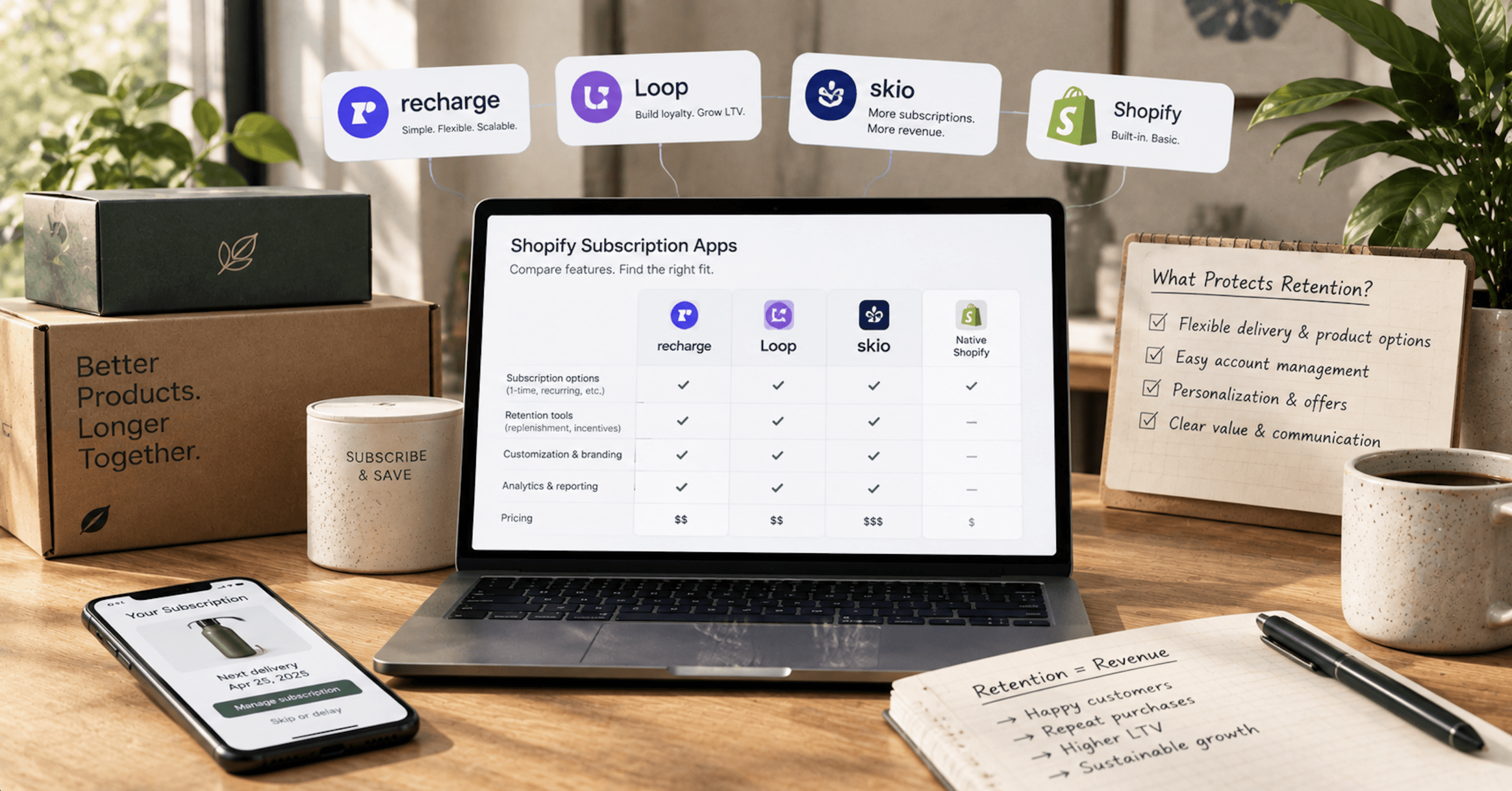
Two of the names on most subscription shortlists now belong to the same company. Recharge acquired Skio in April 2026, and the Shopify App Store listing carries the result in its title, which now reads Skio, a Recharge Company on the Skio listing. The comparison a lot of merchants think they’re running is Recharge versus Loop versus Skio. The comparison actually in front of them has three owners, not four.
Every price, tier, rating and review count below was read off the vendor’s own page or App Store listing on September 8, 2026, and each one links to where it came from. Vendor performance claims are labeled as vendor claims in the sentence where they appear, because none of these four publishes methodology behind them. Pricing on all of these apps moves, so treat the figures as a snapshot and re-check before you sign anything.
We build and migrate these stacks for Shopify brands, and the decision almost never turns on the feature grid. It turns on two questions that don’t come up on a demo call: what your app does when a customer’s card declines, and what it costs you to leave eighteen months from now.
Recharge Owns Skio, So The Best Shopify Subscription App Shortlist Has Three Owners
Recharge published the announcement in April 2026 under a Sydney Weinryb byline, opening with a plain statement: “Today, we announced that Skio is joining the Recharge team.” The same post makes a combined-scale claim in Recharge’s own words, and it’s a vendor claim with no independent audit behind it: “Together, we power more than 20,000 brands and process over $20B in GMV, annually.” That figure appears on Recharge’s own acquisition announcement, and on the wire release below.
On merchant impact, the post is careful. For merchants on both platforms, “nothing is changing today.” Recharge states that both platforms keep operating as they have, that your existing team stays your point of contact, and that it will be reviewing elements of both platforms over the coming months. It closes that section by saying “More details on the combined roadmap are coming in the months ahead.”
The PR Newswire release, dated April 30, 2026, carries the same 20,000-merchant and $20B GMV figures and states no deal value. Neither Recharge’s own post nor the release publishes a price.
Is Skio still an independent company? No. Recharge’s announcement says both platforms will continue to operate as they have, and the two still ship as separate App Store listings today. But choosing between them in 2026 means choosing between two products under one owner whose combined roadmap is explicitly still being decided. If you’re about to sign an annual commitment on Skio, that roadmap position is a fair thing to ask for in writing.
What Leaving Each Shopify Subscription App Costs You
Start with what your app never owned in the first place. On Shopify Checkout, the subscription contract and the tokenized payment method are Shopify objects, not app objects. Shopify’s own documentation for third-party subscription apps says that uninstalling deletes the subscription data created in the app after 48 hours, and it specifically excludes subscription contracts and customer payment information from that deletion, per the subscriptions overview.
That exclusion is the whole reason app-to-app migration is possible on Shopify at all. It’s also why exit cost varies so much between these four: the contract layer is portable, and everything each vendor built on top of it is not.
Recharge's Shopify Checkout Conversion Is A One-Way Door
This section applies to stores still on the legacy Recharge Checkout. Install Recharge fresh today and you land on the Shopify Checkout Integration from the start, so none of it reaches you. Recharge’s help center documents the conversion from Recharge Checkout on Shopify to the Shopify Checkout Integration, and it’s blunt about reversibility on the conversion preparation page.
Due to contracts between Recharge and Shopify, once a store is converted to the Shopify Checkout, Recharge cannot revert the store back to the Recharge Checkout.
Recharge publishes no calendar sunset date for the legacy Recharge Checkout as of September 8, 2026, but it does publish the deprecation itself. Its platform-identification guide calls Recharge Checkout on Shopify a deprecated version of the app and states that a store still on it must convert to the Shopify Checkout Integration to process new checkout orders. So the conversion isn’t optional, only unscheduled. Treat it as the checkout optimization work it partly is, because your subscription conversion path changes with it.
The same page documents three constraints that land on the day you convert. Customers can’t be added manually to the Shopify Checkout with payment methods entered afterward, because in Recharge’s words, “All new customers will need to complete an online checkout via Shopify’s Checkout page so their payment information is stored and tokenized appropriately.” SKU is not available as a condition, search or action in Recharge Workflows. And stores processing more than 10,000 orders per day risk hitting Shopify’s API throttle limit.
Two more that hit merchandising directly. Different shipping rates for one-time versus subscription products sit in open beta, and Recharge documents that duplicate shipping rates currently show at checkout for subscription products with different frequencies. Separately, Recharge’s SMS opt-in has to live on the cart page rather than the checkout page under the Shopify Checkout Integration.
Two Live Payment Relationships, Indefinitely
Same scope: this is a consequence of converting, not of using Recharge. The part of the conversion with no end date attached is the payments arrangement. Existing subscribers keep processing through your legacy provider, whether that’s Stripe, Braintree or Authorize.net, while new customers process through Shopify Payments or another eligible subscription gateway. Recharge states the consequence directly on the same conversion page: “This means that you must keep both your legacy payment provider and Shopify Payments accounts connected and active.”
So a converted store runs two payment relationships for as long as any pre-conversion subscriber is still active. Card updates, gateway key rotations and reconciliation all happen twice. That’s a permanent operational line item, and it doesn’t show up on any pricing page.
No Shopify Subscription App Owns Your Payment Tokens
Three vendors document the same boundary independently, each writing about its own product, and together they tell you where portability actually stops.
Recharge’s migrating away guide tells departing merchants that if they’re leaving Shopify while using a Shopify payment method like Shopify Payments, they need to contact Shopify Support to get those payment tokens, and that Shopify’s export method for payment tokens is a one-off service that may come with a charge. The same page adds a note that some token data, such as the customer_payment_method_id, may be stored with your payment processor, and that you have to reach out to the processor directly to get it.
Skio’s documentation says it doesn’t store payment method data in its own database. Per its data migration overview, the data sits with the payment processor and Skio uses the processor’s API to associate the right token with the subscription in Shopify. Because it never holds the tokens, it can’t move them between two different processors. Skio’s migrations marketing page advertises payment token mapping across Shopify Payments, Stripe, Braintree, PayPal and Authorize.net, which reads considerably stronger than the help doc; the help doc is the one describing the mechanism.
Loop documents the same wall from the other side. Its migration process article states that Shopify doesn’t allow payment tokens to move across two Shopify stores, so Loop uses placeholder tokens in that scenario and customers are prompted to update their card at the next billing attempt.
Can you switch apps without making customers re-enter their cards? Within one Shopify store, on Shopify Checkout, usually yes, because the contract and the payment method stay on Shopify’s side of the line. Across two Shopify stores, or across two different processors, the default answer is no.
Two of the three document a paid escape, though. Loop’s own FAQ names a Shopify PAN migration service, a paid option it puts at around $16,000, that can transfer tokens between stores, and Skio documents a Shopify Payments team transfer path. Skio’s docs go further on one specific case: its team can’t migrate ShopPay payment methods from one store to another, and the docs say it isn’t currently clear whether Shopify’s own Payments team can, per its store-to-store migration considerations. Portability is bounded by the processor and the store, not by the app’s goodwill.
The Free Shopify Subscription App Has The Harshest Uninstall
Shopify’s help documentation for its own first-party app describes what happens when you remove it. Uninstalling Shopify Subscriptions means you can no longer view or access the app’s features, and the subscription plans and contracts created in the app, along with any discounts that use Shopify Subscriptions, are deleted and no longer accessible. A request also goes to the app developer within 48 hours to delete all personal customer information. That’s on the app settings page.
Read that next to the third-party rule quoted at the top of this section and the asymmetry is the whole point. For third-party apps, contracts and payment information are excluded from deletion. For the free first-party app, contracts created in it are described as deleted. Same platform, different exit.
Recharge sits at the other extreme, and its risk runs the opposite direction. Its migration guide states that canceling your ecommerce store, such as Shopify or BigCommerce, will not automatically stop activity on your Recharge account, because they’re separate systems. It goes on: “Until you formally cancel, Recharge continues processing existing subscription orders.” And: “The account must be cancelled or billing will continue. It is important to cancel your account before subscriptions become enabled on the new provider to avoid double-billing your customers.”
Two more Recharge exit details that cost time rather than money. The guide states that “Recharge does not have a built-in notification to alert customers that subscriptions will be ending. It is the responsibility of the store owner to alert customers of any changes or cancellations to their subscriptions.” It also notes that canceling an account or deactivating a flow doesn’t remove customers already inside that flow, so they keep receiving emails until they finish it, and that any custom code such as Ajax calls pointing at the Recharge checkout has to be removed by you.
Recharge’s own recommended export list before you leave, from the same guide, is the checklist to run on any vendor:
- Subscriptions, all
- Charges, queued
- Customer payment tokens
- Payment methods, all
- Customer records
- Orders, prepaid queued
- Orders, prepaid processed
What Migrating In Actually Involves
Loop documents a three-step migration covering customer migration, payment import and subscription import, with customer migration required only when you’re coming from a non-Shopify platform, and payment import required either from a non-Shopify platform or from a legacy checkout such as Bold v1 or Recharge on legacy checkout. Its rule of thumb is roughly one hour per 800 contracts, migrated subscriptions keep their created_at, cancelled_at and paused_at dates, and historical order data doesn’t come across during a subscription migration. Loop states its White Glove Migration is available on its paid plans at no extra charge, and recommends self-serve only below 50 subscriptions, all on its migration process article.
Skio’s model is different in a way that changes your cutover plan. Per its data migration overview, Skio copies subscription data in rather than moving it, so the old subscription program keeps existing until you delete the legacy app, and you have to cancel, delete or disable billing on the previous platform yourself. Canceled subscriptions can’t be migrated at all. Any subscription that arrives without a valid payment method routes automatically into Skio’s Payment Recovery system.
Recharge gates migration help behind its mid tier. End-to-end migration support and hands-on implementation are listed under Plus, not Starter, on the Recharge pricing page. If you’re moving several thousand contracts onto Starter, the migration is yours to run.
How Each Shopify Subscription App Handles A Failed Card
Dunning is the retry logic your app runs when a subscriber’s card declines. It’s the difference between a customer who never noticed their card expired and a customer whose subscription quietly ended. All four apps do it. Three of the four let you set the intervals and the terminal action, and one doesn’t, which is the difference that decides more than the feature grid does.
Recharge's Shopify Subscription App Doesn't Expose Retry Intervals
Recharge’s Failed Payment Recovery uses smart retry technology rather than a fixed schedule. Retry timing is adjusted dynamically based on factors including the payment error type, customer behavior and historical performance across merchants, and merchants don’t configure the intervals manually. The Failed Payment Recovery documentation states the terminal behavior in one sentence: “If all retry attempts fail, the associated subscriptions are automatically canceled with the reason Failed Payment flow max retries.”
The same page carves out one class of failure entirely: “Charges that fail with a hard-decline error code don’t enter the strategy.” A stolen-card or account-closed decline never gets retried, which is correct behavior and also means your recovery rate is measured against a smaller denominator than you might assume.
Recharge markets the outcome as recovering up to 88% of failed payments with AI-powered retries and smart notifications, which is Recharge’s own unaudited marketing claim on its pricing page with no methodology, sample size or measurement period published alongside it. Treat it the way you’d treat any vendor’s uplift number.
Here’s the fair concession, and it cuts against the easy read. An automated strategy tuned on cross-merchant data can beat a schedule a merchant configured badly and never revisited. Not exposing the intervals isn’t automatically worse. It does mean you can’t test them, can’t align them with your billing calendar, and can’t choose pause instead of cancel when retries run out.
Loop, Skio And Shopify Publish Retry Counts And Intervals
Loop’s Starter card on the Loop App Store listing lists smart dunning management with 15 retries at the $99 tier. Its recovery via retries documentation describes retries running on a configured schedule until the payment succeeds or the maximum attempt count is reached, after which Loop takes the merchant’s chosen terminal action: skip the failed cycle and keep the subscription active, pause it, or cancel it. Loop’s own documented recommendation is pause. Merchants can also set a hard stop for specific failure reasons inside Payment Recovery, though hard-decline handling sits on Pro rather than Starter.
Shopify’s native app exposes the same three controls. Merchants set the number of retry attempts, the number of days between attempts, and the action taken when all attempts have failed, choosing between skip, pause and cancel, per the Shopify Subscriptions app settings. The same billing-attempt logic covers both a failed payment capture and insufficient inventory, and a customer notification goes out in each case.
Two Shopify platform behaviors sit underneath all of this regardless of app. Per Shopify’s considerations page, billing runs the day after the subscription is due, at 10:00 am store local time. And subsequent renewals fail if the original order was flagged as high risk and remains unfulfilled, per Shopify’s subscription order documentation. A stalled fraud review on order one silently kills the rest of the contract.
What Skio Documents About Retries
Skio publishes the most granular retry model of the four, and lists Payment Recovery Campaigns with Timing Optimization among its Scale features. Its Payment Recovery documentation describes recovery campaigns built from multiple retry phases, each with its own number of billing attempts and its own retry interval, rather than a single global retry limit. Skio’s own starting recommendation is a first phase set to a 3-day interval across 7 total attempts.
A Smart Retries toggle sits on top of that. With it on, Skio decides the time of day, day of week and day of month for each attempt, and the docs state your configured total number of retries is still respected while the interval may be adjusted. Discount codes can be applied automatically inside a chosen retry phase.
The dunning window is described as ending when the subscription either renews successfully or is canceled. Skio lists Smart Payment Recovery as an included Scale feature on the Skio App Store listing, and documents that a subscription migrated in without a valid payment method routes automatically into Payment Recovery.
Shopify Subscription App Pricing In 2026, Every Published Tier
App Store cards aren’t the full price list for any of these vendors, and the gaps run in both directions. Recharge’s App Store listing carries a $25 per month entry plan with no transaction fees for your first 50 subscribers, and that plan appears nowhere on the Recharge pricing page. The pricing page carries a Custom volume-based tier that the App Store listing doesn’t show. Loop and Skio both publish Enterprise tiers on their own sites that their listings stop short of.
| App | Free plan or trial | Published paid tiers | App-level transaction fee |
|---|---|---|---|
| Recharge | No free plan. 60-day free trial on the listing | $25/mo (App Store listing only), Starter $99/mo, Plus $499/mo, Custom volume-based (pricing page only) | 1.49% + 19¢ on Starter, 1.34% + 19¢ on Plus. None on the $25 plan for the first 50 subscribers |
| Loop Subscriptions | Free Forever up to 50 active subscriptions. 14-day trial | Starter $99/mo, Pro $399/mo, Enterprise negotiable (Loop’s site only) | 1.0% on Starter, 0.75% on Pro, $0 per order on both |
| Skio | None shown on the listing | Scale $599/mo billed monthly or $499/mo billed annually ($5,988/yr), Enterprise custom (Skio’s site only) | 1% + 20¢ on orders involving a subscription |
| Shopify Subscriptions | Free | None | None. Your payment gateway still charges its own processing rates |
Recharge’s figures come from its pricing page and its App Store listing, Loop’s from its pricing page and listing, Skio’s from its pricing page and listing, and Shopify’s from the Shopify Subscriptions listing. Recharge’s listing also notes that external charges may be billed by Recharge separately from your Shopify invoice, which matters for anyone reconciling app spend out of Shopify billing alone.
The free-trial spread is the clearest asymmetry in the set. Recharge gives you 60 days, Loop gives you 14 plus a permanently free plan capped at 50 active subscriptions, and Skio’s listing shows no trial and no free tier. Skio’s annual commitment checks out arithmetically: $5,988 divided by 12 is exactly $499, and against $599 billed monthly over twelve months at $7,188, the annual plan saves $1,200, or 16.7%, which is the 17% saving the listing advertises.
What does a subscription app actually cost at your volume? Here’s our own math off those published list prices, applying each percentage to subscription order value and each cent fee per subscription order. At 1,000 subscription orders a month and a $60 average order value, so $60,000 in subscription volume: Recharge Starter runs $99 plus $894 plus $190, or $1,183, and Recharge Plus runs $1,493.
Loop Starter runs $99 plus $600, or $699, and Loop Pro runs $849. Skio Scale runs $1,299 on the annual rate and $1,399 billed monthly.
That’s a $484 monthly gap between Loop Starter and Recharge Starter at identical volume, or $5,808 a year, before anyone has compared a single feature.
Scale it up and the picture changes shape. At 10,000 subscription orders a month and a $50 average order value, Loop publishes its own worked example on its pricing page landing at roughly $4,149 a month on Pro, billed month to month. That’s Loop’s own example built on Loop’s own assumed order value, not an independent benchmark, and our arithmetic reproduces it: $500,000 at 0.75% is $3,750, plus the $399 platform fee. At that same volume, Recharge Plus at list price comes to $9,099 and Skio Scale on the annual rate comes to $7,499.
The honest caveat on those big numbers is that list price is unlikely to be what a merchant at 10,000 subscription orders a month actually pays. Recharge publishes a Custom tier with volume-based rates and Skio publishes an Enterprise tier, both of which exist precisely because the published percentages stop making sense at scale. Use list-price arithmetic to build your negotiating position, not your budget.
Two break-even points are worth calculating before you pick a tier, because both are pure arithmetic off the published rates. Recharge Plus overtakes Starter when the 0.15 point rate difference covers the $400 platform gap, which happens at about $267,000 a month in subscription volume. Loop Pro overtakes Starter at exactly $120,000 a month, where the 0.25 point difference covers $300. Below those lines, the cheaper platform fee wins and the upsell doesn’t.
Star Ratings Don't Identify The Best Shopify Subscription Apps 2026 Will Reward
The four listings show Recharge at 4.8 across 3,118 reviews, launched October 14, 2014; Loop at 5.0 across 748 reviews, launched July 27, 2021; Skio at 5.0 across 241 reviews, launched April 27, 2021; and Shopify Subscriptions at 3.7 across 803 reviews, launched January 31, 2024. All four figures come from the listings themselves.
A 4.8 held across 3,118 reviews over twelve years is a harder thing to hold than a 5.0 across 241 reviews over five, and the star average alone inverts that. Recharge’s distribution does carry 5% one-star reviews, 148 of them, which a 4.8 average smooths over. Loop’s shows 735 five-star ratings out of 748, and Skio’s shows 235 out of 241.
Shopify’s own app is the only genuinely negative distribution in the set: 47% five-star, 19% one-star, 155 of those. Free, first party, and the worst reviewed of the four.
One thing not to read as evidence: the “What merchants think” summary block on these listings is generated by Shopify Magic, which the listing itself discloses in the page. It’s machine-generated from reviews, not editorial, and it isn’t merchant testimony.
Where Each Shopify Subscription App Gates Its Features
Feature availability matters less than which tier it sits on, and that’s where the four diverge most cheaply.
| Capability | Recharge | Loop | Skio | Shopify Subscriptions |
|---|---|---|---|---|
| Bundles / build-a-box | Plus and above | Starter | Scale | Not compatible with the app |
| Prepaid subscriptions | Supported | Pro | Migrates with billing cycles preserved | Supported at platform level, billing cycles can’t be edited |
| Cancel-flow / save-offer builder | Starter and above | Starter | Scale | Not documented as of Sept 8, 2026 |
| SMS | Concierge SMS, Plus and above, plus per-segment charges | Email campaigns on Starter | SkioSMS one-way and two-way, included on Scale | Customizable email templates |
| Merchant-set retry intervals | No | Yes | Yes, per retry phase | Yes |
Bundles are the sharpest gate. Loop puts fixed and build-your-own bundles on its $99 Starter plan, while Recharge lists customizable bundles and tiered discounts under Plus at $499, per the Recharge pricing page and the Loop listing. If build-a-box is central to your program, that single line moves your monthly floor by $400.
Is Shopify’s own subscription app good enough? For a straightforward subscribe-and-save program, often yes. It supports digital and physical products, subscribe-and-save, fixed and custom pricing, works with Checkout, customer accounts, POS and Admin, and it’s open source, with the listing linking the reference app on GitHub. But Shopify’s own considerations page states that bundles aren’t compatible with the Shopify Subscriptions app, and no cancel-flow or save-offer builder appears in its documentation. Those are the two things that most directly protect subscriber retention, and one of them is documented as incompatible.
The platform constraints underneath the native app apply to third-party apps too where they’re platform-level. Eligible gateways are Shopify Payments, PayPal Express, Authorize.net, Adyen and Stripe, with availability varying by region and terms of service. Customers can’t use local payment methods to buy subscriptions.
Subscriptions can’t be used with draft orders, and the order edits API doesn’t support subscriptions. Shopify Scripts that discount subscription costs or shipping apply only to the first payment, and so do gift cards.
On the API side, you can query up to one year of billing cycles after the last time you updated or billed the contract, and edits are limited to the current cycle plus cycles up to one year out, per Shopify’s billing cycles documentation. Contracts that existed before October 1, 2022 only have billing cycles starting from that date. And billing cycles can’t be edited for prepaid subscriptions at all, which is the constraint that catches prepaid programs mid-flight.
POS carries its own set. Subscriptions on POS require Shopify POS app version 10.13 or later with Shopify Payments enabled, subscription-only products aren’t supported on POS, and POS UI extensions need API version 2025-10 or later, per the Shopify subscriptions developer docs.
Portals And Passwordless Login, Compared Across Four Apps
Passwordless portal access gets sold as a differentiator, and three of the four document it. What differs is the mechanism and its limits.
Recharge sends a four-digit access code by email and SMS, letting customers reach the portal without signing into their Shopify account, with Multipass available additionally to Shopify Plus merchants. Two documented constraints come with it, both quoted from the passwordless login documentation: “SMS delivery of the four-digit access code only works with U.S. and Canadian phone numbers (+1 country code). If your customer uses an international number, they’ll receive the access code by email instead.” And: “You cannot edit or customize the email and SMS messages that customers receive with their 4-digit code.” CBD sellers get email delivery only, and custom portals implement passwordless through Recharge’s JavaScript SDK.
Loop uses a standalone subscription login page with emailed magic links instead. Its customer portal documentation covers skipping upcoming orders with an optional cap on consecutive skips, pause and resume, product swaps, gifting an upcoming order while keeping the rest of the schedule, placing the next order immediately, address changes, billing and delivery interval changes with discount recalculation, payment method updates, discount codes, adding one-time items, and upsell flows. Subscribers can reach the portal regardless of subscription status.
Skio’s listing names a no-code customer portal plus passwordless login and quick actions. Shopify’s native app documents cancel, skip and pause for customers, with payment methods and shipping addresses managed through Shopify customer accounts.
If international subscribers are a meaningful share of your file, the Recharge SMS limit is the one to weigh. Everyone gets a code; only US and Canadian numbers get it by text.
Recharge and Skio also treat SMS itself very differently, and it’s a real buying input. Recharge puts Concierge SMS on Plus at $499 a month and adds a per-segment charge on top, published on its pricing page as $0.03 for US and Canada and $0.06 international. Skio bundles SkioSMS into its Scale plan and describes it as free and in-house on its SkioSMS documentation, covering both one-way notifications and two-way subscription management by text.
One Shopify Change That Hits Whichever Subscription App You Pick
Skio’s help center documents a Shopify platform change that has nothing to do with which subscription app you choose. Shopify is moving to a new payments infrastructure that requires third-party gateways such as Authorize.net and Stripe to connect through the updated system, and merchants may receive an email carrying an upgrade deadline. Skio’s guidance is to disable legacy gateways after upgrading, to avoid duplicate charges or routing problems, and it notes that Skio doesn’t process payments directly, so transactions may not process as expected if the gateways aren’t updated. That’s on Skio’s payments infrastructure page, which states no specific date.
If you’re running subscriptions on a non-Shopify-Payments gateway, that’s your operational risk this year regardless of app. Check whether that email has already landed in someone’s inbox at your company.
How To Choose The Best Shopify Subscription App For Your Store
The best Shopify subscription app for a brand doing $40,000 a month in subscription volume isn’t the best Shopify subscription app for one doing $500,000, and the reason is arithmetic rather than features. Here’s the position we’d take with a client, with the conditions attached.
Under 50 active subscriptions, or still proving the model. Loop’s Free Forever plan caps at 50 active subscriptions and Shopify’s native app carries no platform fee at any volume, so both let you prove the model without a subscription bill. Loop’s free tier gives you a customer portal and analytics.
Pick based on the exit rather than the feature list. Contracts created in the native app are documented as deleted on uninstall, and the third-party rule excludes contracts and payment information from deletion. That difference is worth more than any feature at this stage.
A DTC brand under roughly $120,000 a month in subscription volume that needs bundles and dunning control. Loop Starter at $99 with a 1.0% fee is where we’d start, because fixed and build-your-own bundles, personalized cancellation flows and smart dunning all sit on the entry tier, and the break-even against Pro is $120,000 a month of subscription volume.
Read Loop’s own plan table before you commit, though. Win-back campaigns, automation flows, cancel-flow A/B testing, backup payment method and hard-decline handling are all Pro features, and Recharge puts win-backs and automated workflows on its $99 Starter. If those matter to your program, the $99-versus-$99 comparison stops being one-sided and the decision moves back to the transaction rate.
A brand that needs Recharge’s ecosystem, or is already on it. Recharge’s 4.8 across 3,118 reviews and its twelve-year track record are real, and its migration support at Plus is real. What you accept going in depends on which Recharge you’re buying. Install fresh in 2026 and you land on the Shopify Checkout Integration from the start, per Recharge’s own platform guide, which reserves that path for merchants who installed after November 2, 2020.
The live constraint for a new install is the dunning one: you can’t configure or test your retry intervals, and when retries run out the subscription is canceled rather than paused. If you’re one of the stores still on the deprecated Recharge Checkout, add two more. The conversion can’t be reversed, and afterward you’ll run two payment provider accounts for as long as any pre-conversion subscriber is active.
A brand considering Skio. Its published floor is the highest in the set at $499 a month on an annual commitment, there’s no trial or free tier on the listing, and no retry schedule is published. Given that Recharge now owns it and the combined roadmap is still under review, get the roadmap position, the retry behavior and the exit terms in writing before you sign twelve months.
A simple subscribe-and-save program with no bundles. Shopify Subscriptions costs nothing at the app layer and your gateway keeps charging its own processing rates, so the savings against Loop Starter at $60,000 of monthly subscription volume are about $699 a month. That’s genuine money. Weigh it against a documented bundle incompatibility, no documented save-offer builder, and the harshest uninstall of the four.
The two questions to bring to every demo call are the same ones this whole comparison runs on. What exactly happens on retry attempt one, retry attempt five, and the attempt after the last one. And what specifically comes with you if you leave in two years: the contracts, the tokens, the flows, or none of it.
Scoping A Shopify Subscription App Migration
You built a subscription program that people actually renew. The app underneath it shouldn’t be the reason a subscriber disappears over an expired card, or the reason a replatform quotes six figures you never budgeted.
If you’re weighing a move, a renewal, or a Recharge checkout conversion you’ve been putting off, talk to us about scoping it. We’ll map your contracts, your tokens, your processor relationships and your dunning rules before anyone touches an install button, so you know what leaves with you and what doesn’t. Not a sales call. Not a quote request.
If you want the shorter version first, start with a free Growth Audit and we’ll show you where your subscription revenue is leaking and why. Here’s how BLKDG works as a Shopify Partner once the audit points somewhere.


SMS Marketing for Ecommerce: The Build That Stays Compliant
Nothing reset SMS list-building in 2026. This is the build we’d hand a Shopify brand: the consent, revocation, carrier and state rules that actually bind you, the first flows to text, a platform picked on published pricing, and an RCS registration clock that starts now.

AI Shopping in 2026: Getting Discovered in AI and Closing the Sale on Your Own Store
An AI shopping assistant compares the options, filters by budget, reads your product page, and hands the buyer to your checkout already sold. What happens next is entirely on you. Here’s what that handoff costs, what it protects, and where the orders actually show up.

Abandoned Cart Email: The Recovery Flow That Earns Its Send
A randomized field experiment found cart reminders sent 30 minutes to an hour after abandonment produced fewer purchases than sending nothing at all. This is the abandoned cart email flow we’d build instead, covering timing, discounts, one well-placed text, and who you’re actually allowed to email.
Not sure where the gap is? That's exactly what the Digital Marketing Growth Audit is for.
A free, no-obligation look at where your site can win more traffic and conversions, with a clear digital marketing roadmap to get there. Just a straight read on where your digital presence stands and where it's headed.